Great Sorceror Zebeir, greatest among the Spider Clan’s sorcerers, flailed in the dark as his bodyguards screamed, hacking blindly with their blades. He heard the scratching of fangs on plate-mail, and the muffled sound of thick webs being torn blindly by cursed steel.
Then he felt the pressure, the vice like grip of the venomous fangs as they sank into his flesh and pumped their deadly load into his veins. He flailed with a hand and grasped his fingers around a hairy limb of the arachnid. In the pitch black he couldn’t see it, he couldn’t see anything, nothing except the mild glint of its array of night-eyes.
The venom flowed, the pain intensified, and Zebeir grimaced. Besides him, the last of the plate armoured warriors lay dying, body now fully paralysed by the cave spider’s deadly toxins.
But Zebeir was not one of them. Zebeir was not weak. With a screech, black, hairy limbs burst from his torso, fangs the size of short swords erupted from his maw, and his own eyes split, and split again, as his true spirit violently shed its the human form he now adopted only for spellcasting convenience. The Aspect of the spider manifested, and with satisfied glee, he impaled the pitiful creature on his fangs. The world came into view clearly now, guided by his arachnid eyes….only the thin film of ichor from the body once his own obscured his vision.
Secured to the cave by his many great legs, granted vision by the aspect of the spider, Zebeir continued on his mission, to go deeper into the God cave than any before him.
—
The City of Hinom – a realm beyond ours
I am energy. I am the one. I am the power of the thrones lifting me above and beyond everything I was before. From every corner of the world flows a primal energy, the very stuff of the spheres beyond.
I am Pantokrator, and I am vengeful.
—
The City of Machaka – a realm beyond ours
I am here, energy, malice, power, lording over the city of the Lions.
The ground beneath me (or is it beneath me? what meaning does space have to me now?) is charred to a cinder. I know why. In a fit of pointless resistance, the lords of Machaka had conscripted one of Rhuax’ kin to conjure a storm of fire that roasted the land to a cinder.
Heresy, a heresy that hand burned many of the faithful.
So I am here, and I declare my presence.
Every being hears me, they hear me as a voice that comes from the air itself.
“I am the lord your God, and you shall bow before me now.”
There is movement in the city now, men on the walls point, the gates fly open and the pitiful colossi rush forward, garbed in their quaint lion pelts. From the other gates, the spider clans and the hyena creatures flee in terror. They are sensible, there is yet hope for them….but there can be none for the Lion Clan and their false God.
I am dizzy, disoriented, unused to this form, but I understand that I can move now. Move as I never could for during the centuries past. My form of light and mist advances, and I boom out my warning again.
The lion warriors do not break stride, and one brings their great club down apon my mist-form ankle.
and….I feel something. I feel something. I feel, pain, HOW CAN I FEEL PAIN?
Their foul weapons are an insult, unacceptable, and I WILL NOT BE HARMED BY THEM.
Now, I am golden, my hide hard as metal once more, and by my will the gates open, and from the squares of Hinom my beloved Melquarts and their Rephaite warriors stream through. I see lions impaled and hoisted high upon dawn blades, before being devoured raw by the lords of my chosen people. I feel joy as the blood flows, as the blood of so many virgins flowed to enlist hellfire to my aid.
I am the One, and I am Vengeful. I will see the usurper in Tartarian chains.
I stand before the Stone walls of Machaka, almost quaint constructions of mud and stone, not the great fortifications of Hinnom. I reach my will into the earth, calling on the energies of Barthurax’ kin and the powers of my thrones. I desire it, and so the Earth opens, and the gate collapses into the pit of the Earth.
My giants stream forward into the city, and the blood feast begins, while my dawn guard and Melquarts escort me up the hill towards the final bastion of these “great men of the Mabebwe.”
The Lions offer resistance at every turn. They jump upon my giants from hiding places, while their sorcerers conjure great magics and curses. A rain of fiery projectiles lands around me, follwed by masses of blades upon the win, slicing into my men wherever a gap in their armour can be found. Such things are beneath me now, and so with a whim the skin of my faithful becomes golden, hard as metal and immune to the assault. The Melquarts cackle as they rain down blows, and one of my favorites impales a war lion on the his great horns.
The Lions resist, why do they bother resisting?
Their temerity brings anger to me, and so I turn left upon the concentrated huts of the outer city, where I know so many of the heretics live. In time they could believe, but they made their choice when they did not flee like the wise. I look to the sky and call to the spheres. When the great rocks from the sky smash into the ground trailed by lines of flame and fire, they throw up great plumes of dust that cloak the entire city. I can see their souls rise by the thousand from the destroyed district. They will be banished to the underworld for their crimes, but they are lucky, I do not force them to live in chains for eternity the way I will their lord.
The gate to halls of the “funny guy” are large enough to admit me, and I march my armoured bulk between the statues of the great Bouda and the Mighty Lion. Inside I am assailed. Here the spell casting elite are gathered. Boudas and Lion Royalty, all of them throw their mightiest spells. Beside me, a gold skinned Rephaite is turned to ash by a gesture. Before me, an entire squad of my dawn-guard are torn limb from limb by immortal beings, raised from the underworld to fight.
I banish them.
I incinerate them.
I scour all of them from existence.
With a roar my breath becomes white fire, hotter than any burning sun, and I melt the seats, the viewing galleries, and set fire to every fixture and fitting.
In the end, as the fires reside, only the mightiest of the Machakans is left. A single battered creature, the one they had all fought to defend. A blast of mental energy tears the protective mask off and banishes the protective wards that had insulated him even from my inferno. I smile as his skin begins to char from the heat. The creature looks at me, and then begins to morph its shape. It is a hyena now, fur singed or burning, blood dripping from growing wounds. As his energy fades though, I anger, I feel no divine spark. This cannot be the one.
“I am your God. Bow before me and reveal to me the location of your master!”
I reach into its mind, expecting to find something pliable, something malleable.
But there is nothing. Like an empty void, like I am seeing a puppet, not a person.
The burning ….thing looks up at me, its eyes now chafing as the last of its tears evaporate.
And it laughs. It cackles like a Hyena, it hacks out laughter that I feel even in my divine core.
It laughs until I blink and burn the puppet the ash.
I am the Pantokrator, and I am a fool
The God Cave – a realm beyond ours
Funny Guy, the mighty pretender of Machaka, he who defied death, plunged further into the blackness. In life these caves would have been too much for him, but in death, with his skin now leather, and his entire frame covered in the finest of magical armour, it was like a second home.
Lion Clan myth banned exploration of the cave, and none who delved into its deepest corners had ever returned. None bar Funny Guy.
It was in the God Cave that he had first found the secret to taking on the divine spark. It was in the God Cave that he had discovered his mission….
And it was in the God cave that he had first found a place where the boundaries between the spheres were weak, maleable, where shadows of other worlds sometimes crossed into the corner of the eye in the pitch black.
Now he was in that place again….and he looked through the corner of his eye, listened at the edge of his hearing.
He saw, and he heard.
The God Cave – Present Day
Zebeir’s spidery legs carried him down, and down, and down, until he reached what he was sure was the deepest atrium.
The walls here were otherworldly, smooth, as if carved by a master mason with the finest of tools. In the center, there was a pool of still water.
For the first time, the great sorcerer felt something akin to fear, though he could not understand why. He knew that his mighty body recoiled from the pool, and yet a voice in the edge of his soul urged him forward.
He fired a line of spidersilk from his abdomen and anchored himself to the ceiling, slowly lowering himself to get a better view of the pool.
Even here, where there was no light, the water appeared particularly black, like a void in the universe from which not even his insect eyes could draw an image.
He lowered himself further, and began at last to see himself, a great spider, a lord of the Spider clan.
He lowered himself further, and the image shifted. It wasn’t a spider, it wasn’t him, or was it? the form was wrong, something different. A Hyenna perhaps?
Circulatory system racing, fangs barred he began to climb back up the line of silk.
“no”
The command was simple, and irresistible.
Like a puppet who’s strings had been cut, Zebeir released his hold on the silken thread, and tumbled into the water.
“Our journey across the Ashen wastes to the west was slow, full of fear, and made possible only by the efforts of the shamans and their nature magics that bore some life from the otherwise dead earth.
After what seemed like an eternity, moving only in the day to avoid the horrors of the night, we finally neared our goal. We could smell salt water, see a gentle smoke haze rising from distant signal flames, and hear the distant sounds of battle.
When we crested a rise, we finally saw the great fortification, a silver statue of a ship rising over the central keep and a great supply fleet docked in harbour. The dead were arrayed around it en mass, their banners bearing the old Pegasus symbol of Legio I Audiatrix. The undead had clearly sent some of their best.
We camped, fearfully, quietly that night, speaking among outselves on how best to cross the siege lines and enter the fort. In the end, the decision was made for us, as a team of Phaeacian scouts, men more akin to Aviim than humans, accosted us in the night and, at spearpoint, guided us through a secret entrance, and into the mighty fortress.
By our will or otherwise, we were now participants in the battle for Isaurian.”
17 command centuries, including Arch Bishop Amianus II’s retinue.
Total force: c. 65,000
2nd Army Infantry: 8,450 colossi light infantry
Isaurian Garrison: 800 colossi archers
Local Population: 700 human archers
1st Royal Expeditionary Group: 180 Gigante warriors, 200 Orichalcum guards
18 command centuries, including Dido, 3rd queen of Phaeacia, and 16 detachments of the Phaeacian priesthood.
Total force: c. 12,000
Commanders
Arch Bishop Amianus
Censor Superior Karatus
Seven Auxiliary Mound Kings
3rd Queen Dido of Phaeacia
Senior Storm Captain Barca
Losses
Near total: 90% of engaged forces, all command elements escape
C.7,100. casualties heaviest among infantry corps.
Results
Decisive Phaeacian Victory
Siege of Isaurian broken, Ermorian Western Army effectively ceases to exist.
Subsequent raiding destroys a number of Ermorian temples and prompts entry of R’lyeh into the war alongside Phaeacia.
Background – The blessed Isle and the Ashen Empire
Phaeacia is an island nation, a fusion of old Bertyian and Arcocephalian ideals, famed for its wealth, opulence, culture, and ageless magics.
The island’s great merchant fleet survived the fall of the One, and in the opening years of the ascension wars, the Colossi Queens leveraged the great fleets of black ships, the rich orichalcum mines of Phaeacia, and the martial strength of the colossi and gigantes of the isle of Black Korkya to carve out a maritime empire amid the chaos of the underwater wars and the Ermorian conflicts with Pythium and Ashdod.
When Ashdod came near to falling, it became clear to the rulers of Phaeacia that they faced a choice. Either they could abandon their Eastern colonial holdings along the Ermor border, or they could commit the ritual, financial, and military resources necessary to hold the curse back, and draw a line in the sand before the Ermorian forces.
Bravely, the ruling Queens of the isle chose the latter course, and a great campaign of fortification was commenced, while raiding storm captains were dispatched to assail the Ermorian coastline, seeking temples, sites of magic power, and other resources to deny the ashen empire.
When Ashdod fell, the God in Eldregate at last felt confident enough to confront the Phaeacian ‘affront’ and assembled a great force to march West and eliminate the greatest sign of Phaeacia’s defiance. The great fort city which dominated the province of Isurian.
Isur’s Bastion
Long Walls to the Sea- Isur’s Bastion
“we entered the bastion by nightfall, and only when day broke could I truly appreciate its scale. This was no fort, this was a fortified city, packed with soldiers and civilians alike, ringed by a mighty wall. Such a site both impressed and horrified me, for no besieged force could hope to sustain so many thousands of civilians for an extended period of time.
As we were escorted above the markets and homes of the protected populous, eventually the ocean once again came into view and I had my answer. Two long walls stretched from the city out towards the ocean, several kilometers distant. the sun glinted from the shields of the warriors who patrolled the walls, as a stream of carts flowed both towards and away from the fortified bastion, towards the distant fleet.
“The long walls to Utique, where the black ships make dock” offered my captor and guide, “as long as they stand we will hold here, long after the dead have been ground back into dust by the passage of time.”
It is well understood that not all societies take the same approach to creating fortified positions. Some, like us, prefer to create small, heavily fortified structures designed to allow purely military contingents to hold out for extended periods of time. Others, like the Nazcans, create only rudimentary structures displaying their primitive natures.
Phaeacians do not produce fortified structures, they fortify entire cities, giving protection to the entire population during times of crisis.
So it was at Isur’s Bastion.
With a population running up to the better part of a hundred thousand, the city was the hub for all Phaeacian operations in the East. It housed a great temple, arcane laboratories, arms workshops, and all the infrastructure required to support military and commercial operations.
Constructed Inland atop a raised position blessed with a fresh water aquifer, Isur’s bastion was hypothetically vulnerable to the fate that befalls so many great fortresses…being starved into submission.
Unwilling to risk that, Phaeacia’s masons embarked a second great siege-works project, linking the fortified town to the sea by a kilometers long stretch of curtain wall. There, the port-town of Utique was built, guaranteeing supplies to the great city.
The view of the long walls from Utique to Isur’s Bastion
The result was a great fort that required an extensive garrison and support force to man its walls, but which could, if properly guarded, hold out against a much larger sieging force almost indefinitely.
While immortal, an indefinite hold out was something Ermor could ill afford, being at war on multiple fronts, and so the stage was set for the conflict to come.
Initial Dispositions – The Bastion and the Wall Breakers
Both the Phaeacian royalty and the black Senate in Ermor understood that Isur’s Bastion was critical to their ongoing war efforts, though perhaps somewhat more important to the Phaeacians than the Ashen Legions.
Without it, Phaeacia would be denied a forward port from which to project force against Ermor, and they would be denied the riches of their holdings on the Isaurian peninsula which jutted out of the growing Ashen Empire like a dagger in its side. For the Ashen Empire, the fortress demanded military allocations that could be used elsewhere, against Nazca, Caelum, Shinuyama, or any of the other forces against which they were engaged.
Both sides therefore committed considerable forces:
Ermor dedicated two fully raised and constituted legions, namely Legio I Audiatrix and Legio III Augusta as the core of the force. 25,000 skeletal combat veterans were a considerable force, significantly larger than the armies that had recently triumphed over Ashdod and the Shinuyama border forces.
These troops were augmented by the 4th Lictorian Legion, near its 2,500 strong full complement, and more than a thousand knights of the unholy sephulcre detached from the Imperial Singularion horse. These troops made up the dominant share of the army’s killing power, blessed as they were by Arch Bishop Amianus and his team of higher clergy and attendants. Amianus had been one of the first Arch-Bishops raised after the fall, and was known as a dedicated agent of the Ashen God’s will.
In order to carry out siege works, the Ermorian force also included more than thirty thousand auxiliary troops, primarily longdead warriors and ghouls. The latter part were also included as a deliberate insult to the Phaeacian rivals, for many of those afflicted by the hunger were Phaeacian civilians from those provinces that had fallen to Ermor during the earlier stages of the war.
The Phaeacian military was not to leave the challenge unanswered however and in the months preceding and even during the siege, thousands of reinforcing troops were sailed into the city.
While Phaeacia is famed for its great fleets of ships, its armies should not be underestimated, made up as they are primarily by the great colossi. This noble, dark skinned race traces their lineage from back through the Berytian Empire to a time when a tribal clan of collosi ruled the realm of Machaka. These ‘great men of the Mababwe’ were unparalleled warriors, either in Machakan or Berytian service, but on the island of Phaeacia they have multiplied in greater numbers than anywhere else, and now they serve as both rulers and the base of the military arm of that oceanic empire.
The overwhelming majority of the Phaeacian expeditionary army at Isaurian was thus made up of light collosi infantry, equipped in the standard Phaeacian pattern. This mean great warriors armed with shields, spears, and javalins, as well as linothorax armour in the late Arcocephalian style. While the shield and helms were heavy pieces, the linothorax itself is a much lighter, less protective piece. This is chosen for reasons of both fighting style and production costs. The lighter armour permits quite an athletic fighting style even in hotter climates, and encourages proactive use of shield and spear to prevent attacks, rather than risking taking them on the armour. The armour can also be more easily created than the large cast metal pieces required to create single piece metal armour for these larger than life figures.
At Isur’s Bastion, the Phaeacian 2nd Infantry Army presented itself with an established force of 8,500 colossi. These were divided into 170 bands of fifty warriors each. These bands were themselves usually paired with each other on the frontline to allow for some rotation and redundancy at any given point on the front. Operational army command was exercised by the Senior Storm Captain, while overarching command fell the the local representative of the Phaeacian monarchy, the mighty Queen Dido.
While each of these warriors was a formidable force, the Phaeacian defence plan acknowledged the sheer size of the perimeter that would need to be defended. Men had to be found to fill the gap, and so the local Governor managed to muster seven hundred human archers from the local population, mostly small game hunters and foresters. He also contributed the entire colossi garrison, some 800 bow equipped warriors.
This brought the strength of the Phaeacian infantry to more than 10,000, reducing the ratio of attackers to defenders to a ‘mere’ six to one.
The scale of the Phaeacian preparations were no secret. the practice of counting ships disgorging reinforcements was not unknown to Ermor’s veterans, and Amianus arrived knowing that his opponent had brought a significant force to defend their walls.
With an extensive siege perimeter to garrison and a large opposing force capable of moving up and down its own line with ease thanks to the long walls, Amianus, acting on the advice of his Censors, quickly opted against the idea of trying to starve out his opponents or launch a general assault all along the perimeter.
Instead, he divided his forces with economy in mind. Legio III was divided up and stretched into positions along both sides of the long walls. Undead legionaries took up positions out of bowshot, and then stood sentry, motionless, tireless, watching for any sign of enemy sallies from concealed ports along the wall. The bulk of the legion faced Utique itself, standing guard before the port’s walls, again seeking to guard against any attempted raids by Phaeacian forces…and pinning down at least some of Isur’s garrison in the port fortification.
The bulk of the Auxilia and the first Legion were set against the market sector of the wall, where the Ermorian veterans faced a combination of flatter land, a large gate, and a salient in the wall perimeter that would limit the amount of missile fire that could be brought to bear on the attackers. The plan then was to concentrate against he market gate, breach it via undermining, and then to throw 1st Legion and the 4th Lictorian Legion into the breach, screened by as many soulless, longdead, and ghouls as the army could muster.
The undermining process would take the better part of six months, slowed by proactive sallies and assaults by the Phaeacian forces that more than once forced entire sections of the siege line to be abandoned. Casualties were relatively limited, as both sides tried to limit their losses.
The Phaeacian army, now squarely under the command of the third Queen of Phaeacia, did not waste this short breaths. reinforcements were sailed in by the black ships, intended directly to answer the Ermorian plan that was becoming apparent. Troops would be needed that could hold the breach against the lictors and cavalry…and a way would be needed to put them in the grave.
The solution settled on was to bring in a small corps of Phaeacia’s finest troops to hold the expected breach should all else fail. Two hundred of the elite orichalcum guard were sent from the fabled island itself to put their coppery armour to the test against the undead. Then, at the final line, one hundred and eighty gigante warriors, honouring their ancient oaths and carrying within them the military traditions of old Mekone, stood ready to hold until the very end. These last troops were the rarest of Phaeacia’s infantry, but they stood head and shoulders above the rest, matching rephaites in size but far eclipsing the fallen giants in skill, discipline, and equipment. For those of us who know the tale of Mekone’s fall and the bastard tyrants of distant Phlegra, to see some these Gigantes in service was almost humbling.
But spears, even giant spears, could not answer the undead hordes…not forever. Skeletons in particular are quite resistant to stabbing injuries and they would not tire in the way the colossi and gigantes would….and so a thousand more reinforcements were brought in, humble and small of stature. And then the Phaeacians waited for the gate to fall..
The Horde Cometh – The Ermorian Assault
“For weeks on end we watched the hordes beyond the wall, saw as more and more legionaries marched from their distant posts along our walls and arrayed themselves in silent ranks before the gate. They no longer cared about our ability to move or resupply, they just stood, silent, motionless, rotting, while the husks that still recalled their old sapping skills continued their work beneath our feet.
The collapse happened in the morning thankfully, a failure on the part of the Ermorian engineers no doubt. At just after 8am on what the Phaeacians informed me was the three hundredth day of the siege campaign, the earth shook, we heard the grating crunch of cracking stone and saw the fissures run up the flanks of the curtain wall. When the gatehouse fell, it fell outward, much of the ruble serving to fill in preparatory ditches they had dug for exactly that purpose.
One of the storm Captain’s aids had lent me a magnifying device they normally used in seafaring to enable me to survey the enemy force. On the tallest hill, amidst the gilded finery of purple and black silk tents and pennants, I saw the foul creature Amianus, distinctive enough in his white robes. He raised his hand, then lowered it.
As one, the horde began to shamble forward.
At the blaring of a trumpet, the first block of colossi marched towards the breach.
At the second sounding, they raised their shield and readied their javelins. Well behind them, and behind the blocks of reserves, the robed humans waited in their hundreds.
I looked to the aid of the storm captain, a great giant with me on the observation platform. Noting my gaze he spoke, as if to the horizon.
“I worship the spirits of this city, the will of the sea, and the awakening God. By their will, today I will deny death, and stand unbroken.”
For my part, my hand rested on my blade…for comfort if nothing else. After what I had seen this last year, I had little faith in spirits.”
When the assault came, it was, as expected, lead by the great masses of soulless and shambling longdead, their unlife intended for sacrifice at the alter of whatever defence was expected of the Phaeacian could offer.
That defence took the form first of a volley of arrows from the walls, then another, and another.
Arrows embedded in soulless flesh or bounced through skeletal bodies, and the dead kept coming, albeit now with a more pincushion like appearance. With each step they drew closer to the breach, a compressed mob twenty thousand strong. The Colossi readied themselves to meet the baying horde…and then the chanting commenced.
Amidst a thousand other robed figures, a young priest, Hanno, turned his palms up to the sky as he said the words.
His hands shook as the noise of battle washed over him, but he chanted the first verse, calling on the Lord of the South Winds to cast his eye upon the battlefield.
Sweat flowed down his brow as colossi soldiers flowed forward through the lose formation of the faithful. He canted the second verse, calling on He who Tempers the Spirit, to calm the hearts of the faithful and guard them the abominations of death made animate.
Calm. Calm confidence washed over him as he half-yelled the final verse, invoking the power of the Lord of Stellar Lights to BANISH the foul undead back to the underworld from whence they came.
From the heavenly spheres, a beam of light shone down. Where it landed, the longdead puppets stumbled, and crumpled into a pile of bones, a dozen souls or more, once more at peace.
Hanno could not see the results of course, his ritual willed to target beyond the mostly still intact wall. But from the battlements the archers called back, and word went down the line that it was working. That their God’s power was with them.
Hanno exhaled to steady himself….and then began chanting once more, and all around him, others did exactly the same.
The First Challenge- The First Legion’s Assault
From his position on the hill, it is held that Arch-Bishop Amianus was unmoved as the rain of lights from the sky cleared his fodder hundreds of animates at a time. Like wheat before a scythe, the blocking force fell before the breach, barely any making contact.
As if personally insulted by the display, the Lord Bishop and his attendants completed their own incantations, invoking the King of Men’s fates, the Ashen God, to grant his protection upon Ermor’s legionaries as they marched to a destiny of a reborn Empire. The magics holding their bones together stiffened, the slackness of their motions lessened.
And then the Censors commanded first legion forward.
Like the longdead before them, the legionaries (or rather their bones) advanced through a hail of banishing evocations, as the Phaeacian devout called upon their god for aid. Unlike the longdead before them, the legionaries did not immediately crumple unto dust. They would stumble, fray, maybe see a limb detach as the animating energies conserved themselves with less of the body. It was enough for them to make contact with the defences, a moment heralded by a great voley of rusted pila thrown into the waiting block of colossi.
Some of the great men fell, only a few at first, then more, as the press of spears met.
Skill, strength, and vigour all clearly favoured the Phaeacians. They threw skilled thrusts aimed at collapsing the diaphram, severing the spinal column, or breaking the flow of energies between limb joints. It was skill and strength enough to overcome the defences of the Ermorian infantry, though dozens of colossi did fall to weight of numbers, javelins, and determined thrust by spear and gladio alike.
As the dead pressed forward though, locked in a shoving of shields against their giant opponents, the priests brought the rain of holy light in closer, showering it over the front line. And while the magics of Amianus permeated their bones, in time, faith again began to win out, and the legion began to perish en masse.
It was working.
Blood and Horror- Amianus commits the 4th
As the losses among the mindless mounted, the very much mindful leaders of the Ermorian force must have taken stock. More than six months had been committed to this siege, along with one of the largest forces the Ashen Empire had mustered to date…and here it was, three and a half hours into an assault, with nought to show for it but a growing pile of bones and rotting flesh on the approach to the breach.
Longdead were one thing, their loss could be reported to the capital much as one might speak of the expenditure of ammunition or marching boots…but the loss of the 1st might have implications for other fronts, given the time that would be needed to gather and reanimate the bones once more.
Phaeacian records suggest that unease passed among the Ermorian commanders as well at this point, their chill winds flaring out anxiously as the Censors met and debated the best course. What happened next would seem to suggest that they came to the conclusion that the fort must be taken at all cost, lest face be lost. After all, they were not fighting the Pythian or Scelarian traitors, nor even the rebelious provinces of Ulm or Marignon….they fought living Barbarians, and to leave the field to such people could not be countenanced.
Among Pythian lines, the infantry were tired, but confident. An entire morning of fighting had yielded reasonably low casualties, and the work of the priests was proving up to the task. For the first time since the Ashen Empire reduced Ashdod to ruin, their perceived invincibility was beginning to fray.
Then the call from the wall came down.
Horses, skeletal horses, and the banner of the Singularion Cavalry…the knights of the unholy sephulcre.
Order were quickly yelled and the tired phaeacian colossi set themselves in defensive formation once more, harried by the last few legionaire longdead that simply refused to stop moving. The enemy cavalry came on with an unnatural quickness, their steeds racing across the field at a rate none of the men had ever imagined possible.
As the Phaeacian infantry readied their javalins, the knights of the unholy sephulcre lowered their lances, and broke into a full gallop.
It is a well known fact that all but the most trained of war horses will baulk at charging a line of prepared spears. It is for that reason that Ermor’s cavalry has long been used primarily for harrying actions and charges against broken or flanked enemies.
Undead horses have no such qualms.
A thousand knights barreled into the Phaeacian formation like ballistic projectiles, slamming full tilt into the line, lances hunting for enemies as the riders swung their spatha with unholy, mechanical drive. In seconds, casualties mounted as entire swathes were cut through the forward ranks, and the soulless riders sliced in, hacking in every direction, until at last a steel-nerved phaeacian could see the opening and land a few hard spear thrusts and shatter the enchantment.
The priests also said their words, but the speed of the exchange…bones for blood, limited their effectiveness for the first time in the battle. Now the fighting was being done by the poor, bloody infantry in earnest.
It was a brief fight, the suicidally offensive charge left the knights surrounded and outnumbered wherever they gained purchase and penetrated into the infantry blocks. But for each knight finally returned to the grave, fully two or three colossi were slain by its unholy motivating magics.
In harsh terms, it was an exchange that likely favoured the Phaeacians on the surface. In mere minutes the Ermorians had exhausted their entire cavalry force, and such troops were not as easily replaced as the light soldiery of Phaeacia.
But as the battered forward units struggled to find their footing on a ground now slicked with blood, covered with bodies, and strewn with bones, the reason for the Ermorian charge became clear to the Phaeacian commanders watching from above.
The Ermorian 4th Lictorian Legion, the slayers of the Rephaim, conquerors of Ashdod, were marching into the fight…and they were about to find a disordered, tired, near broken enemy formation in their way. And the 3rd Augusta marched at their back for good measure.
The Phaeacian commanders could do little but watch with some horror as yet again, the arrows from the walls rained down harmlessly on the leathery hide of the Ermorian troops, and the unnaturally quick shock-troopers of the Ashen god flowed into the Colossi and began the slaughter. Small teams also, exercising the initiative that their minds allowed them, began filtering up onto the walls, where they cackled as they buried their axes in the helpless archers now trapped on the battlements.
From his position, Senior Storm Captain Barca watched the melee develop, remaining pensive as others displayed apprehension. Using a vision device and the support of several aides, he went about an unusual battlefield manoever.
He began counting.
He counted for how long it seemed a line of his warriors could better the enemy with skill before their chilling aura inhibited their movements and allowed the lictors to finally combine axe-head with flesh. He counted how many lictors were put back in the grave every time the priests completed their incantations and another barrage of holy light rained down from above.
Like a Captain calculating whether or not an intercept course at sea was possible given known winds, he summed and accounted for each variable then, with a grimness worthy of Ermorian priest, he ordered the second line of infantry forward to bolster the first.
Half an hour of combat passed, as the banishment rained down and Colossi fell before the lictorian axes. Fell, but fell slowly.
He ordered the Third line forward, now having fully expended more than half of his infantry forces. He calculated they would stand for approximately forty minutes before the cold and fatigue overwhelmed them. When he checked the time node upon ordering the 4th line forward, he saw they had lasted thirty eight.
Enemy attrition, his aides informed him from their own counts, remained on track.
It was now creeping into the late afternoon, and the Phaeacian infantry was a shadow of its former self. Casualties were above 75 per cent at this point, and the smell of blood and slain bodies was begining to reach even the upper quarters of the city.
The priests, having been chanting since the early morning, were clearly wearying, as young boys and girls raced among them, pouring water into their mouths in stolen moments between verses.
The frontline had been pressed back, and was now perhaps no more than fifteen meters from the first of the priests. Hanno could actually now see the undead, foul leathery things on the other side of the phaeacian press…and the hint of their unnatural coldness lashed across his face.
Confidence was fading in his heart again, but licking his painfully dry lips, he began his chant once more.
Barca confirmed his estimates, the Phaeacian infantry were near breaking point..but the Ermorian horde was now a shadow of itself as well. Thousands more legionaries had been sent to the grave, and the lictors too had paid with the overwhelming majority of their number. They had come within meters of his priests….now they only had to be held.
But as the Phaeacian infantry faltered, the aggregate total of a few minutes here and there, where his troops had broken before he anticipated, seemed to be adding up to a stark realization….they could not hold alone.
Turning his vision device to the distant hill, he could still see the tattered Imperial Banners, and the robed figures. His enemies sensing an inevitable triumph.
Turning to an aid, he gave the last command he could think to give.
“send them in”
The Thin Gold Line – The Pledge Of Black Korkyra
“once they were known as monsters, oppressors, and tyrants. This day they were saviors.”
Hanno’s heart raced despite his exhaustion. He could SEE the line in front of him tiring. He could feel the cold as it manifested in icycles on his last, battered defenders…and he could hear the sickening sound of axe meeting flesh, muffled by armor on the way in and out.
He thought for a moment about pausing his ritual, so he might give his own soul its final rites, but he banished the thinking as selfish, and continued his banishment.
His ritual was interupted however but the slightest shake in the ground, and the *clank* sound of metal armoured feet on cobbled stone pavement. Shadow cast itself over him as giants, true giants jogged past him in perfect order. At the fore, one with a robe commanded the others, giving orders in a language he could not understand.
The gold armoured titans fanned out, sixty wide, three deep, setting themselves between the priests and the Ermorians. A few yelled forward in the Phaeacian tongue, calling on the colossi to fall back, something they did with glee.
They raced back between the giants, he stood perfectly still. Then the first lictors seemed about to close, and a command was given. A foreign word he none the less recognised, as it had been directly adopted by so many other nations.
“PHALANX”
The front line of giants compressed, brought their shield forward, and with a clang, locked the mammoth metal constructs together in a wall of bronze.
Spears slide forward through the gaps, as the second and third rank bolstered the first.
As the first lictors made contact, the gigante warriors went to work with their spears, and Hanno would later write that he saw a lictor’s torso caved in and run through by a single thrust of giant sized spear.
The lictors were far from helpless of course. Where a few axes found gaps in the shields, a task their quickness enabled, their colossal strength and choice of weapon allowed them to fell a number of Black Korkyra’s own, as they had once felled the Rephaim…but the Rephaim had not worn armour like this, had not fought in formation like this, and were not this skilled in the art of battle.
From his posting, Captain Barca saw his golden line hold strong, mere meters from his banishers.
He saw the last of the Lictors began to falter….and then to run.
Pursued by the honoured sons of Black Korkyra, true inheritors of the best of old Mekone, the last few of Ermor’s mindful undead raced from the field.
On the distant hill in the siege camp, the purple banners were struck and packed away, as Amianus and his Censors cast their mind to how best to justify what they had just witnessed.
A victory for the living
Aftermath – A Reprieve for the Living
The battle for Isur’s Bastion resulted in very little immediate change in terms of territory holdings. Phaeacia would retake the provinces immediately surrounding the fortress, and would raise a temple to the Ashen God in the process. Beyond that however, Ermor’s reserves and the limited ability of Phaeacian troops to advance into the ashlands without starving meant that further advances could not occur. In that sense, the battle seemed to change little.
Nor were the losses themselves totally decisive to either side. Even before the curse, Ermor was known for its ability to rapidly recover from defeats, and within a few months Ermor would again be putting pressure on the bastion. Within a year, it would be launching another siege. Phaeacia too was able to rapidly make up its losses, colossi being mobilised across Phaeacian holdings far faster than they were being killed on the Isur peninsula.
But strategically, operationally, and diplomatically, the battle’s impact was felt across the world.
Strategically, the collapse of the siege of Isur’s bastion was a major reverse for the campaign of Imperial restoration. Had the bastion fallen, it was likely Amianus army, complete with new reinforcements, would have moved on to new offensive operations elsewhere. Whether this took the form of an offensive into the great inland sea, or reinforcement of the Caelian or Shinuyaman fronts with an additional sixty thousand bodies is impossible to know. What is know is that, coupled with a similarly decisive defeat at the hands of Caelum, Isur’s bastion likely explains the persistence of resistance to the expanding Ermorian demense in the far East.
The defeat also meant that Phaeacia would persist as a strategic threat. Raiding, preaching, and serving to hold back the curse from the peninsula, a persistent thorn in the side of the God in Eldregate, sucking in additional resources for a year or more to come.
Operationally, the defeat also proved a learning experience for both sides. Phaeacia tested, and proved, the concepts first developed based on observations of the disastrous Ashdod conflict. The focus was shifted from using infantry to kill the undead, who would always have the numbers advantage, towards a focus on simply holding the horde in place, using a combination of walls and tough infantry, to allow time for massed batteries of preachers to undo the enchantments animating the dead. Once that was done, it peeled away the ablative walls of bone and flesh surrounding the Lictorian corps, who could then be (with great difficulty) put down by sufficiently hard-hitting troops capable of overcoming their tough hide and armour.
The experiment proved costly for the infantry of course, but it proved that if the right tools were brought to bear, the legions could be stopped.
Ermor too learned lessons. In the siege context, unlike in a field battle, the soulless and longdead had proven essentially useless. Only the 4th legion and the Knights of Eldregate had found any purchase in the Phaeacian line, with the chaff serving only to bog down the conflict and run up the Ermorian loss count. In future battles, the focus would be on bringing larger numbers of lictors to the field, and leaving the chaff to do the siege work.
Magic too would be an increasing area of focus for all sides. Ermor sought to find ways to turn its natural strengths to its advantage and break these grinding deadlocks, exploring the secrets of enchantment magic to find ways to tire or wear down the living.
Phaeacia, knowing new tools must be coming, would try to find ways to more effectively slaughter the Ermorian sacreds, who proved so resistant to banishment. They looked to the skies, and set their researchers to finding the answer.
But it was the diplomatic implications that made the battle perhaps most notable.
Phaeacia had won a battle and proven a battle could be won. In doing so, it effectively confirmed its own untouchable status in international affairs.
For powers watching from afar, wondering if Phaeacia would fall (and thus become a target to be salvaged from Ermor) or if their stand would succeed, Isur’s Bastion gave them their answer. Inspired by the example of the colossi on the peninsula, the otherworldly creatures of R’lyeh would shortly join the war, and commit mages and troops against the Imperial coast.
The Lady of Rainbows, the God of Ys, would similarly be moved by the Phaeacian plight, and would join the war within a few months of the battle, opening up a narrow flank near old Ashdod.
And to the bird people of Nazca, once tacit allies of the undead when fear of Ashdod had run high, similarly took note. They would commence their own offensives near Ashdod, seizing several provinces, perhaps overconfident in their ability to press into the Ashlands even without magical supply items or support from their sacred flocks still busy operating in the South.
For a while, confidence ran high among the coalition of the living.
It would take a number of subsequent, crushing defeats to deflate that confidence back to a more sober level, but even those defeats would not expunge the memory of Isur’s bastion…the first place where any living power had successfully defied the will of the Ashen Empire.
“My lord, Ashdod is destroyed, but by now I imagine that you would have heard this brought no salvation to your brother’s lands. They are now ruled by hordes of the dead who fly the banners of old Ermor. Having seen the great power of these monsters, I have embarked on an infiltration of the lands of the old Empire to report in greater detail on the threat.”
-warrior-sage Sir John Kyriell
“The destiny of Ermor is no different now than it was the day it was first foretold by shrouded prophet. Ermor, with Eldregate as its capital, shall rule the world, and all will pay her homage. The eternal city will be the seat of an awakened god who will bring the peace and law of Ermor to this world, and to all of the Spheres of being.
…and any who would stand it the way of that destiny; any traitor, apostate, or abomination, will die at the the hands of the legions and rise to pay their penance in eternal service to the lord of the Eternal City.”
– Declaration of the Arch Bishops of Eldregate on their first assembly following the great ritual.
The ruins of Eldregate
National Background – The Empire and the Great Ritual
“I had gathered with me a small team of former slaves with whom I had escaped the lands of Ashdod before its final fall. Many of the escapees had chosen to go home, but a few, having seen what I had, were willing to help advance my mission to understand this threat and take that knowledge back to their homes before death came for them as well. We packed what supplies we could and, with the guidance of one who had lived within the Ashen Empire’s border prior to its conquest by Ashdod, began a journey towards those outer provinces”
Ermor itself needs no introduction to those of us with longer memories than the average pond-fish. For centuries, and well into the last decades of the One’s rule, Ermor was an ever expanding Empire of mankind. From the great city of Eldregate, Ermor lead the conquest of much of the world by humanity, driving back, or even utterly destroying the monsters and abominations that had ruled the land since the ages of myth.
With the exception of the peoples of Phaecia (who owe their existence to old Berytos), Machaka (old allies of Ermor) and those who trace their lineage from Arcocephale, almost all the humans of this world must acknowledge the role Ermor played in making even our independent fiefdoms a possibility.
At its height, Ermor was all but unstoppable. The city of Eldregate grew to be home to more than a million men and women, and the borders of the Empire stretched from Eldregate to the swamps of Pythia, through the lands of Ulm and old Marverni, and over the waters even to the edges of Machaka. Fueled by a religious fervor, brought by the prophet in white, Ermor alone awaited the fall of the one, and the a coming of a new god….an Ermorian god.
At their peak, grand games in Eldregate could draw hundreds of thousands of spectators across multiple arenas.
But the Empire’s success concealed growing corruption and darkness. As well as grain and wealth, her legions brought back knowledge and secrets from the lands they subjugated or made tributaries…including from the Androphags of Sauromatia and the Sauromancers of C’tis. In the capital, the elite order of mages, the Augur Elders, experimented ever more flagrantly with the employment of death magic, using it to cement their control at the expense of the older mage-priest orders.
As the rituals grew darker, with the full ascent of the Bishops of the Ermorian prophet, disquiet grew elsewhere in the Empire. Two centres of power in particular defied the ritual practices in ever more public fashions. Firstly, the Campus Sceleris, the great centre of magical research that had turned into a city-state all of its own, ruling vast tracts of land south of Ermor. There, an order of Thaumaturgs, formed again from the order of augurs, looked to the stars and with knowledge over death foresaw a great doom. Their predictions were given added weight by the wealth, power, and influence of the Emerald city of Pythium, which had increasingly grown to dominate the rich but distant provinces of the Empire. There, Theurgs whispered warnings in the ears of the Dynatkoi, and the seeds of actions were sown.
The Theurgs of Pythium were some of the first to speak out against the Augur Elders in Eldregate
Fifteen years before the One disappeared, the Emorian Empire’s brother declared that his elder sibling was unfit to rule, acquiescing as he did to the evils of the Augur Elders in Eldregate. When the Bishops of Eldregate declared the younger Caesar a heretic for his claims, the excommunicate called for banners to be raised in rebellion. Both Pythium and the Campus Scelaris answered the insurgent’s call, while the core lands of old Ermor rallied to Eldregate. Thus began a devastating civil war that would stretch into the final days of the old era.
As legions annihilated one another only to be raised again, annihilated again, and raised again year after year, Ermor’s power, wealth, and influence faded. Seeing their chance, many lands like ours declared their indpendence. Ermor could no longer protect us, and we saw no reason to pay taxes to fund a war that seemed so distant and irrelevant while we went hungry. The great provices of Ulm and Marignon similarly declared independence, while the recently subjugated lands of Man, freed from the Tuatha, similarly declared they would have nought to do with the struggles of the brothers.
It was towards the end of the war when the powers of the One began to fade, and the shackles he had placed on magic began to wane. By this point, the forces of the Pythine provinces and the Campus Scelaris had proven too much for old Ermor, and the great city itself had been placed under siege.
Eldregate had never been designed to endure a lengthy siege. Her storehouses were vast to be sure, but a million people cannot live in one place off stores forever. Eldregate was a city of agricultural imports, grain and livestock coming in from C’tis, Machaka, and fish and kelp being sold by the various oceanic civilisations. While some food could be smuggled in, it was paltry compared to the needs of the city, and by the final days of the siege, 15,000 men and women a day were dying of disease and malnutrition.
The battle of Cerialis Bridge marked the moment that the first Pythian legions entered the territory of Eldergate propper, and the closing days of Eldregate’s hopes in the civil war.
Whether it was all of this death, the pain and passing of so many, or the weakening of the one that allowed what happened next, we will likely never know. What we do know is that with the presence of the One only a faint echo, the dark mages of Eldregate convened, and at the direction of the bishops, the starving people of Eldregate began a ritual intended to fuel the magics of the mages.
We have no direct witness to what happened next, none bar the Elders that is, but the fable holds that farmers at the tips of the horizon saw the skies darken, a faint glow of purple and black take hold on the horizon, and then, in a single sickening moment, a bleeding wound in reality opened where old Eldregate had once stood.
The men of the sieging army decayed and died where they stood. The citizens of Elregate, begging for salvation, were taken by a great wind of death and died. Plants browned and shriveled, livestock breathed their last, and all but the strongest of the assembled death mages decayed and lay dead or dying on the cold stone of the grand chamber.
It was now, as the greatest city in the world laying dying by its own hubris and the folly of man, that the last tethers of the one to this world were released, the mortal plane plunged into chaos, and the use of magic was remade but left unfettered. Whether it was the act of Eldregate’s demise that caused the one to leave at last is beyond anyone’s ken, but I have to wonder if the lord felt such discuss in that moment that he deigned to abandon the world.
As the Ashen Empire would tell the story, with the enemy army slain, the survivors, the most powerful elder mages and bishops protected by items or magic of great power, looked out on a shattered empire. leagues of cropland in every direction were now barren, the greatest city of the Empire derelict of life, the great provinces were in revolt and the coffers of the Empire were empty. Ermor, holy, blessed Ermor, the Empire that was to rule all in the name of the coming god, seemed entirely lost. Parts of the temple precinct themselves were blown apart, and stone fell down from the temple hill onto the common city below, just like the hopes of the old empire.
In that moment, where all will to live seemed about to leave them, a new presence whispered to them from beyond the fractures they had opened to the realm of the dead. A presence showed them images of the Empire at its height, it spoke of their destiny, and declared that from this darkness, Ermor might rise to bring order, to bring pain, to bring death to all that had dared to try to bring the Great Empire down. The presence claimed that it, was the coming proclaimed by the shrouded prophet, it was the force that would renew the empire, and bring about the destiny of the greatest empire that ever was or will be.
With their bodies literally expiring by the minute, but animated by their magics and spirits, the last Augur Elders lent their power to allowing the spirit to manifest. The spirit of an Empire remade.
A spirit of ash, death, and darkness.
As the augurs died around the manifesting spirit, as it drank deeply of life-force of so many slain, it looked out upon the fields of the dead.
And it commanded them to move.
The Outer Provinces – Auxiliaries and Lies
“We first came to the province of Meer, a former Ashdod territory now fallen under the Ermorian yoke. There, we made contact with a band of totemic tribals two whom several of my companions belonged. Greeting us with joy, they took us into their homes and offered us hospitality. When we asked after the Ermor occupation however, much to my surprise, they seemed rather ambivalent on the whole situation. The tribe informed us that the dead were much like any other rulers. They demanded taxes, they hired many of the tribe as scouts or even preachers, and sent their armies to root out criminals and bandits. As far as they were concerned it seemed, the Ashen Ermor was no different from the Ermor of old, barring the slightly desiccated state of its enforcement officers.
The outer provinces of Ermor are defined as those where the worship of Renovatio Imperii has not yet been adopted in any way, but which fall under the military control of Ermor.
In these provinces, life seems to continue much as it did prior to their conquest, barring the old trappings of Ermorian occupation. As in the days of the old Empire, local magistrates visit various population centres to ensure taxes are levied accordingly, officials see to the hiring of local manpower, and laws are enforced harshly but fairly.
An Ermorian town in the outer provinces, where life seems normal enough, better perhaps than before.
Many of the officials in these areas are locals, particularly at the lowest levels of seniority. But the lictors, the senior law enforcement officials, are all undead. In occupied lands these dead men apparently tend towards the wearing of masks and scents to cover some of the worse aspects of their condition. They grasp the old symbols of office and speak of the law and the Empire rising from a disaster that almost destroyed it. Undeath is shown as an opportunity for those truly dedicated to the Empire to continue service past their own death, an opportunity at immortality in exchange for patriotic service.
That and financial compensation are the two paths we found that entice living humans to first consider acquising to Ermor’s occupation, and then, in time, considering turning to the worship of the new God.
These territories make up much of Ermor’s landholdings and I assume they are vital in providing valuable coin and goods to Ermor itself.
Leadership and Mages: Scouts and shamans
It is generally accepted that most undead make exceedingly poor spies, and also tend to be all but useless in leveraging anything outside their native magical school of death.
Perhaps as a result of this, the Ashen Empire draws on the old Ermorian tradition of hiring locals as auxiliaries to its own forces. My understanding is that a few talented nature mages have been recruited from among the various tribal peoples, along with sigificant numbers of trackers. These men are paid by taxes levied on the living populations of these lands.
A few misguided souls also tend to be recruited as priests of the new god, but only once a temple has been raised. And once that occurs, a province is well on its way to joining the inner circle of provinces, as we would soon discover.
Military Forces: A few collaborators
Given its relatively limited economy, Ermor does not normally go to the expense of raising significant auxiliary armies from the outer provinces. I saw a few militia units paid by the Empire, but these seem to be short lived, and within a few months of occupation they have been largely replaced in Meer by ghouls and souless warriors…a frightening sign of things to come.
Overall, the outer provinces are NOT a source of any significant fraction of Ermor’s military strength. They are however at the absolute core of its conventional economy, and their conquest or devastation would likely significantly impact the ability of Ermor to keep up the pretensions of being a benevolent force and a reasonable trade partner.
The Inner Provinces – The Ashen Plains
“I entered the province of Lettia with a small team, disguised as the retinue of one of the shamans traveling and searching for sites of natural magic throughout Ermorian lands.
My heart was heavy as we crossed the border, for it was from here, months prior, that I had marshaled with Isaac and his men to stand against the Ashdod invaders. Now it had been under Ermor’s control for months, and a great temple to the awakened god of Ash had been raised where the old Pantheon once stood.
The transformation in the land itself brought be to tears as we advanced.
We passed lines of refugees gaunt faced and malnourished, who were in the process of fleeing South East, hoping to reach the outer provinces or the realms of Shinuyama or Nazca beyond Ermor’s borders. Meetings with a convoy of a few hundred ragged souls, we were told they once numbered in the thousands. The told us that desertion was a crime in Ermor, and that the punishment was undeath and service. Packs of crazed ghouls had set upon them again and again, and almost all of their supplies had been lost during their flight.
I surveyed the ground around me, and could not see so much as a single game animal that might offer some salvation for the hungry. The ground was covered in browned grass, dead or dying, and the trees looked like they too were fading, completely incapable of baring fruit.
My heart heavy, I had our team of tribal shamans conjure their magic briefly. Attaching to a few sparks of life in a great apple tree, they caused it to bring forth fruits before our eyes. In a matter of hours, we could offer at least some paltry ration to these poor souls as they fled.
When we made to leave they clawed at our cloaks, begging us to go with them rather than march further into the heart of Ermor. I recognised one of those pleading as lady Sarai, a wife to one of Isaac’s commanders during our fateful battle.
My heart bleeding, I set off without telling her what had happened to her husband. I could not risk my identity being revealed now…and I did not in my heart believe she would live long enough to mourn him.
The inner provinces of Ermor are those which have been conquered and either had a temple or priests spread the great spell from Eldregate into the land.
They are homes to the dead and the dying, where the land itself is shriveling, the people are fleeing or passing into undeath, and the curse and rituals of the Ermorian faithful work tirelessly to raise more and more thralls for the Elders and their god. They are giant factories to the undead with whom we are most familiar, and are truly awful places to behold.
The Ashen Plains
Leadership and Mages: Kings of Old
Before Ermor conquered these and other lands, the tribal peoples of this and other places would usually entomb their kings in great mounds of earth, complete with the weapons and armour they wore in life.
These were violent times, and most kings and chieftains met violent ends, at least until the peace of Ermor brought order and prosperity to all, including the province of Lettia.
Now, the the great spell, the curse of Eldregate, reaches into the old mounds and raises these chieftains of old to command the great masses on undead born from the curse in the outer provinces.
There is little to note about these kings other than that they are true ‘leader’ undead who retain a mind and identity of their own, rather than being simple puppets guided by spirits or evil magic. A standard leadership cohort will usually be roughly a hundred strong, consisting of the king, a number of attendants likely buried with him, and the armoured remains of his old household warriors. They are known to lead groups of up to 8,000 of the undead, with any more taxing the power of the king to impart his will on the undead.
These leaders are in every way inferior to the true Ermorian leaders and mages we were to encouter later, but with the rapid expansion of Ermor’s forces, I expect the Ashen Empire will make efforts to reannimate as many of these old leaders as possible, to keep their armies under control and mobile, lest they be vulnerable even to carion birds.
Military Forces: The Ghouls and the Soulless tide
The spell unleashed in Eldregate and sustained by their pretender god is likely the single most powerful manifestation of death magic to ever be unleashed. It permeates the earth, emanating out from wherever Ermor is able to erect a ‘temple’ to tie the land to Eldregate and amplify the unholy forces housed there.
My initial research suggests that in essence, the spell functions as a direct ‘tap’ into the wells of necromantic energy that suffuse the realm of the dead. Normally, a mage of death would employ concentration, their innate powers, and ritual to tap into these powers from our material plane of existence. If extra power is required, they might use gems of concentrated death essence, collected from places particularly suffused with death magic. But the ritual at Eldregate effectively turned the Sepulcre in that city into magical font for death magics. This energy is then channeled by the Ashen god, and thus wherever its dominion spreads, so to do the effects of the spell, leaching into the earth from every temple and prophet of Ermor unless the divine energy of another exists to hold it at bay.
Because the spell is embedded in the earth, it is perfectly suited to finding corpses buried long ago, even where they have long since decayed to mere bone dust. The curse gives motive function to these bodies, assembling their bones into limbs. At the direction of the mound kings, other corpses can be directed to help dig these old bones out once the curse enlivens them, and once freed, these old bodies become new skeletal warriors in the armies of ermor, the so called longdead.
The average longdead is almost entirely bone, held together by magic. They have no manifest will of their own and act only as puppets of the mound kings or priests who lead them. Without the presence of this leadership, a longdead will remain completely still, sustained only by the ambient energies of the curse, and be cut down without effort by any opposing force. In the inner provinces, the energies of Ermor reanimate longdead by the hundreds or even thousands every single month, their already reanimated kin digging them from their ancient graves. Given how many thousands of years may have passed, it does not bear thinking about just how many bodies there may be within Ermor’s borders, should they prove willing to dig deeply and allow their magic sufficient time to do its work. So far the Empire seems to prioritise the reanimation of buried warriors, for these are most often recovered with weapons and armour….coroded weapons and armour to be sure, but weapons non the less.
Among the most numerous of Ermor’s troops, the longdead should not be completely written off as troops. They are mindless and thus without fear, and will advance until every single one of their number is destroyed (unless the mage leading them dies first). In terms of skill, those who have fought them suggest that they retain some of the speed and skill they held in life, like an echo of the soul is being captured and used by the energies motivating the body, and equipped as they are with basic weapons, they are not a match, but certainly still a threat, to the average light infantryman.
Fortunately, as their flesh and sinew has long rotted away, a longdead warrior is a brittle being, entirely dependent on a fragile reanimation to hold it together. Banishing rituals will be able to reliably sever these bonds, rendering the creature a harmless pile of bones. Perhaps more practically however, any significant application of force, particularly simple blunt force, will tend to snap unpadded bones, bleed off the energies holding the creature together, and cause the creature to essentially crumple. A determined line of macemen with stout morale and physical endurance would thus be sufficient to see off several times their number in longdead.
It is the harsh reality of these lands however that many of the bodies are not ancient in the slightest. As the curse enters the land and poisons all living things, the human population inevitably suffers a combination of dehydration, starvation, and predation by the undead. Those who fall (and a sickening number do rather than escape) are then easily reanimated by the great spell, and become soulless, for it is not the soul of the deceased residing in the body, but simple necromantic energies, using the body as a natural point of attachment and animation.
In the lands of Ermor, the soulless are seemingly animated in roughly equal proportion to the longdead warriors. Tactically, their role is very different. Unlike the long-dead warriors, the soulless bodies of dead civilians have no soul echo to provide the basis for combat skill, no weapons to increase the threat they pose, and have movements hampered by muscles and flesh in various stages of rotting or degeneration. The result is that these shambling creatures are fodder before all but the least skilled militiamen, and pose almost no threat to better troops.
They are not, however, without utility. With muscles and flesh still linking their bones, a soulless creature is much harder to destroy with mundane trauma than a longdead, and even the use of armour can only do so much to redress this balance. It takes a much more vicious strike to break bone, or bring down a body to a point where the dark energies can no longer motivate it, when dealing with soulless as opposed to skeletal longdead. The result is that these units are often deployed in the opening waves of an attack, to suck up arrows and simple to tire opposing units. The same tactics one would normally deploy when dealing with soulless reanimates apply here….the application of simple banishing rituals. Human tissue resists reanimation, even as its existence makes the reanimated body more durable. The energies of death are not meant to mesh with the artifacts of life, even once they have expired, and so almost no amount of magery can protect swarms of soulless from the rituals of banishment. If priests can be brought to bear, no matter which God they believe in, then they will likely be able to de-animate these beasts by the hundred.
Both of the aforementioned animates are mindless creatures. Bodies animated by necromantic energy. Without direction, they would have no motive energy, and lie motionless and harmless.
If only that were true for all animates…
Humans resist extinction. Humans resist death until their final breath, and sometimes beyond. A cornered man will fight with the ferocity of a lion and the strength of a bear before he is finally felled. Unfortunately, that desperation can drive some to horrific acts.
When food runs low, some in the Ashen lands chose canibalism over starvation. In doing so in lands so suffused with death magic, they often end up surrendering themselves to the condition we call ‘the hunger.’ The hunger transforms the canibals into ravenous beasts, hardening their fingers into harsh claws, decaying the mind, and instilling in them a never-ending hunger for the flesh of their fellow man.
These creatures are not mindless. The soul remains inside the shell, steadily corrupted by that terrible condition. That trait defines their role in Ermor’s army. Because they are not mindless, they can (if their diminished faculties can be overcome) be convinced to flee the field, and as such are generally considered inferior line combatants, or so Ermor’s doctrine would seem to suggest. However, when promised flesh as a bounty, they are able to follow directives without direct supervision, and this makes them infinitely more useful when performing tasks which call for unsupervised labour, particularly the defence of castle walls and the maintenance of fortifications. Ermor will keep thousands or tens of thousands of these creatures inside its walls to hold them against any enemy that tries to break down the defences. They will hold and defend while their enemies struggle to maintain a force in a land where nothing grows, and the living are no longer welcome.
Collectively, the longdead, soulless, and ghouls provide a flawed but powerful military force that have long been the staple for all necromancers. There may, even now, be tens of thousands of them on the march, with higher estimates running above 100,000. In such numbers, the threat they pose cannot be denied.
Unfortunate then that they seem to represent the weaker wing of Ermor’s war machine.
The Core Provinces – The New Empire
“As we traveled west, into the heart of the old Empire, the streams of refugees dissipated into nothing. The sounds of distant screams from persons set upon by the undead faded, and all were left with was the sound of the wind and our own breathing.
Here, nothing lived. The ground was ash, trees were dead, no birds sang, no snakes crawled. There was only silence and the dark, unyielding earth as far as the eye could see.
Nature abhors death on this scale, and so in places evidence of degradation were already evident as rains and riverbanks eroded the dead earth, causing the streams to run so heavy with loose dirt that they too took on an ashen grey look. The dead trees and brush seemed to hold some of the land together, though i wondered how long that could last in the face of the elements. In a few decades, would this land still have any form? This place seemed to be the concept of entropy given form. At least until we advanced further, and reached the first ‘settlement.’
The old camp of Legio VIII Augusta, the legion that once served so famously against the Marverni tribes, had been fully rebuilt. The roads leading to it were paved with neatly cut stone, and the walls raised high with timber and stone. Observing from some distance, we watched as leather skinned bishops, still wearing their white shrouds, spoke the rituals of reanimation over the old legion’s memorial graves, bidding the old legionaries to come forth. one at at time, they rose from their graves with the aid of their brethren, and took their place by maniple, century, and cohort. The standard flying over the fort was the same as it had ever been, the proud bull, now topped not with an eagle, but a silver skull.
The assembled legionaries undertook their drills in silence, but to the barked commands of their lictor overseers, and on the word of the fort’s Censor, made ready to march.
This site filled us again with horror. The Ashen Empire was thought to be full of empty talk. A few mad necromancers with delusions that their necromantic plague had any true connection with the great empire of old was the popular image. But here were the empire’s old leaders, undead but conscious, reviving (in a very literal sense) the Empire’s old and lost glories.
Bypassing the fort and moving further towards Eldregate, we marked fort after fort, each raising undead legionaries from their graves. I personally spotted the thunderbolts of Legio XII Fulminata, the wheel of fortune marker of Legio XV Primigeneia, the proud lion of Legio XVI Flavia Firma and the trident and dolphins of Legio XXX Ulpia. All were legions of the old Ermorian heartland, all had stood with Eldregate against Pythium and the Campus Sceleris, and all had been wiped out nearly to a man in the civil war….and yet here they, and generations of their forebearers were, once more.
It was as i was sketching notes of my first observation of the eagle marker of Legio XXII Primgeneia Pia Fidelis that one of my tribal comrades decided to ask me just how many legions Ermor had fielded, and how many dead Eldregate could possibly raise from the graves of those fallen in the Empire’s service.
I didn’t have the heart to answer him.”
Leadership and Mages: “Survivors” of the Empire’s darkest hour
The power unleashed in Eldregate appears to have killed at least nine hundred and ninety nine out of every thousand souls in the city. Even the Augur Elders and Arch Bishops present and prepared for the great ritual suffered catastrophic casualties, and had their souls carried to the underworld.
But in a city of a million, a casualty rate of 99.9% still yields an estimate of some thousand survivors. The means of their survival varied.
A few were bishops and their acolytes who weathered some of the great wind of death in the warded depths of the old temples, atop the third hill, not the first where the Sepulcher stood. Their faith and distance combined to allow them to retain their minds, even as their bodies decayed and passed into undeath.
Others were a few of the highest Censors of Eldregate. If Ermor’s declarations are to be believed, no magic protected these souls. No wards. No shields. No temple walls. The claim is that they survived simply because to the very core of their being, even after fifteen years of war, even after seeing the capital starve and death itself pour out of the Sephulcre, they refused to accept that this could be an end for Ermor or for Eldregate. Through sheer stubbornest, they won the favour of the awakening god, and were allowed to stand witness as the new God raised the first of their army of renewal and reconquest.
But if justice had any power in the world and these had been the only survivors, Ermor would not be the threat that it currently is. Without mages, without being capable of truly harnessing the great spell, Ermor would be much less threatening, as the secrets of arcane research remained lost to them.
Unfortunately for the world of the living, a few Augurs and Augur elders, those best prepared for the ritual, were able to keep their souls and minds anchored in this world, even as their bodies whithered away entirely. The served on as spirits, their souls anchored in the netherworld, and their craft bolstered by the magical resources of Eldregate.
These three forces now form the trinity that drives the Ermorian war machine forward in a way that no individual piece could manage.
The Censor is the force that makes the will of the Ashen god manifest across the Empire. While the temptation may be to think of all undead as mindless automatons, the Censors continue to carry within them the minds of the former high judges and military leaders of Eldregate. As a result, while they can no longer bare the follies of the living, they are able to draw on a lifetime of the finest education and tactical doctrine that the Empire could devise in leading the reborn undead legions and applying Eldregate’s law and rule in conquered territories not yet neutralised by the curse of Eldregate. They are fearless, capable, and tough leaders.
They are also notable as individual combatants. So strong is the connection of a Censor to the underworld that one can feel the chill winds of that realm emanating from them at twenty-paces. At close engagement distance, this wind is debilitating, and I while I don’t doubt seasoned soldiers could resist it, to do so would be exhausting. They should not be underestimated on the battlefield….the giants of Ashdod did to their great detriment.
Without armies however the Censors would be all but useless to the Ashen Empire, and it is there that the bishops and arch-bishops of Eldregate contribute their part to the genocidal campaign of Imperial reconquest. Still cloaked in the white shrouds of their prophet, the clergy of Eldregate proclaim the divinity of the Ashen god as the one who was foretold by the prophet in white…he would would bring salvation to the Empire in its time of greatest need.
Through this great and utterly ironic heresy (given that Eldregate has already declared an intent to destroy the Ermorian legacy that lives on in Pythium and Scelaria) the bishops are able to channel the divine energies of the Ashen god to terrible effect. They alone are able to erect the great temples which serve as nodes for the great curse, spreading it beyond eldregate, and allowing for additional death energy to be channeled into this world. They alone are able to enact the rituals to summon lictors back from the dead without the wasteful use of death gems, adding elite warriors to the ranks of the Ashen armies. And they alone are able to deploy the perversions of divine magic I saw in Ashdod….the act of giving a divine blessing to undead troops, of giving additional strength to their muscles, speed to their movements and reinforcing their resistance to the diving magic opposing them. Without these leather skinned traitors to everything Ermor once stood for, the Ashen empire likely would have begun, and ended, within the walls of Eldregate.
Finally there are the mages of Ermor. These ghostly figures no longer go by their old titles of Augur or Augur Elder, but instead the junior mages call themselves Spectators, for they will be the ones that watch Ermor’s rise. The Elders now call themselves Dusk Elders, for they will be the ones that see the twilight of this world.
In battle, a Spectator is comparable to a necromancer of average power, capable of summoning new undead in battle or exploring arcane secrets in a laboratory. Their ghostly existence gives them great resistance to cold, and makes killing them with ordinary steel more difficult…but far from impossible. To date few have been seen in battle, and we assume most remain within the walls of Eldregate where they either research new evil magics or use death energy to summon more of their kin back into this world.
By comparison, the Augur Elder is a terrifying creature, such that I expect even seasoned troops would find holding firm against them difficult. They are the most powerful mages of death that I have ever witnessed. A single unit of ten mages with roughly ninety attendants is fully capable of unleashing levels of destruction that would normally require several times their number of spectators to accomplish….and some that would be beyond any number of lesser mages. Perhaps most worryingly, they seem to retain some of their knowledge of the astral spheres from their past lives, as well as the old and sacred path of the flame. These skills allow for the frightening possibility of these mages using communion techniques to enhance themselves yet further, or unleashing banefire on the battlefield. A few even have knowledge of other elemental fields allowing for other elemental magics to be unleashed.
If there is one consolation, it is that drawing the soul of such a powerful departed being back onto this plane, with its mind and powers intact, is surely a magically draining activity. Even Eldregate would struggle to complete such a ritual with any frequency, and few would have the power to complete such rituals, besides the Dusk Elders themselves.
Perhaps that is why no Dusk elder has yet been seen in the field. Heed my warning though. When such beings do finally appear, no effort must be spared to put them back in their graves, for as long as they live, no army is safe from the undead tides, from banefire, or worse.
Military Forces: Death, Drill, and Dizzying Speed.
The forces raised in Ermor’s heartland can be broadly divided into three categories: The reanimated legions, the reanimated elite cavalry, and the lictorian legions. Each poses its own unique threat and fills a distinct roll in the Ashen Empire’s war machine.
The legions form the bulk of Ermor’s military forces outside the hordes of soulless and longdead. These are reanimated legionaries, raised either from the places they fell when the great spell was unleashed from Eldregate, or from their graves of honour at the old legionary forts. With the fields of the Ashen Empire littered with the bodies of fallen armies from the civil war, there is no shortage of weapons with which to equip these bodies.
Given the centrality of legionary service to a legionary’s life, it is perhaps not surprising that enough of an echo remains to allow necromantic magics to chanel some of the martial skills that the legions had during their lives. As a result, while the soulless and longdead march in simple mobs, the Legionaries pantomime the same organisation and combined arms tactics that they employed in life.
Legionary infantry are built around the basic building block of the ‘century’ of a hundred ‘men’. These centuries are then grouped into cohorts of three hundred, responsible for operating together on the battlefield. So ubiquitous of this formation, and so unchanging has it been throughout Ermor’s long history, that when chronicalers or students of war refer to a standard unit of frontage, they refer to the length of front-line covered by a cohort of Ermorian infantry in standard formation.
In terms of equipment, the infantry are grouped into spear and pila armed Velites, main line infantry units armed with stabbing blades and pila, and reserve triarii elements equipped with long spears. In the latter case, reanimation has not preserved all of the tactical techniques of the deceased veterans, and the result is a less densely packed shield and spear formation than once were. That said, most triarii were historically aged veterans in the twilight years of their service, many in their fourties and the eldest moving into their fifties. They were thus known for suffering illness and weakness more often than younger soldiers…but never complaining about it. Old bones however reanimate just as well as young ones, and so this drawback at least has been purged int he process of death and revival.
The legions are augmented, as they were in Ermor’s heyday, but a sacred cavalry arm. Whereas legions largely split on geographical grounds in the civil war, the sacred Equites of the Sacred Shroud remained loyal to the archbishops in Eldregate, almost to a man. Having long eclipsed the general equestrian corps, in reputation and combat effectiveness, these sacred warriors were key to the reason that Eldregate and the Imperial core were able to hold out as long as they did against the wealthier Pythium and the magically endowed and terrifically fortified Campus Sceleris.
But by the time of the siege, most of the corps had been lost in field battles and the remaining few were wiped out when the great catastrophe engulfed Eldregate. While their spirits were freed, their bodies were forever marked by their service, and easy to locate given the fading, but still detectable energies of the sacred shrouds they wore on their bodies. Bereft of a powerful cavalry arm, the bishops have taken to raising the bodies of these warriors again, to serve as sacred cavalry.
As with the legions, the bodies of these riders retain enough of a soul-imprint that the animating forces are able to draw on their old military skill, meaning they remain a dangerous warrior at the best of times. Fragile, perhaps, given that they are essentially longdead in their physical makeup, but skilled and obviously immune to tiring in battle. More significant to their efficacy is the shrouds they still wear. Now inked with the colours of the Ashen God, the shroud forms a sacred anchor on the warrior which can be activated by a bishop or achbishop performing certain unholy rituals. When this is done, the rider and their steed are charged with the divine favour of the Ashen god, and become a force to behold. The energies holding their bodies together are strengthened, meaning that no longer is a single broken bone enough to bleed off the animating energies and leave the body inert. Instead, significant damage is required to put the creature back in its grave. In addition, they are warded against banishment by all but the most powerful of priests, the Ashen god denying others the chance to assault his servants.
Then there is the speed.
A knight charged with the blessing of the God of Imperial Restoration moves with preternatural pace and alacrity. They scythe through formations, cross the field in a flash, and in close combat dodge, parry, and strike with such speed that only warriors of great skill can hope to match them. At such speed, they have been known to slice through lightly armed formations with mechanical efficiency and a complete disdain for life. They ride into battle with much the same equipment they used in life…a standard pattern lance, a broadsword, and the aggression of their undead steed. The standard unit of organisation remains the Turma of 30-40 men, usually paired together to cover the same frontage as an infantry cohort.
If the knights provide the hammer of the army, the undead lictorian legions provide an anvil, an iron bedrock at the core of the undead horde.
Lictors were officials, judges, enforcers, and warriors of old Ermor. As the civil war grew more desperate, they took on greater duties in maintaining order and discipline among legions increasingly staffed with underpaid green recruits and a civilian population that faced greater rationing and deprivation. This role meant that lictors required, above all else, an absolute dedication to Eldregate, to the Bishops, and to the promise of the prophet in white. That dedication, I theorise, is the answer to why their souls are willing to accept reanimation, and why the Bishops of Eldergate see fit to expend great energies and pains to bring them back to this world.
A lictor of the old Empire. During the civil war era, Armour tended to become heavier until it eclipsed legionary standards.
In case I was not clear, Lictors are, like the Bishops and Archbishops, not mindless annimates, they are revived men who have given their fanatical dedication and support to a God who aims to end all life on the material plane. As such, while one may fear the knights of the unholy sepulcher, one should revile the lictor.
Lictors fight with heavy armour, their leathery skin also forming its own layer of protection. They cold winds of the underworld billow around their bodies, and the blessing of the Ashen god readily anchors to them. They carry heavy, two handed, lictorian axes, both as weapons and as symbols of their still enduring oaths of office. Those oaths have survived their deaths (many at the hands of the bishops and elders they now serve) and are given practical effect in the slaughter of Elderegates enemies and the regulation of the living populations of the outer provinces.
They are limited in number of course, requiring either arduous rituals overseen by arch-bishops, or the expenditure of death essence to retrieve the souls directly through magic, but every Lictorian century is a critical threat on the battlefield.
Ermorian Tactics: The Old Legion, Refined
The biggest mistake that all of the Ashen Empire’s enemies have made is to assume that the undead legions are simply some necromancer’s horde of skeletons, coming on them with no organisation or tactics. In reality, the Ermorian army is absolutely still based on the legions of old, with the tactics adapted to leverage the new longdead and souless forces.
The standard formation places a line of longdead or soulless in the frontline, and two more compacted groups on each flank. These groups are intended to absorb missile fire or simply bog down and exhaust enemy cavalry and infantry formations with the effort of cutting them down. Soulless in particular are popular for bogging cavalry, as cavalry will usually have trouble cutting them down in speedy fashion.
Behind the soulless are a think line of velites in skirmish order, followed by the legion proper arrayed in what we would call a double-cohort line (though single line may be used where numbers are lacking).
This central force is expected to do most of the fighting, hurling javalins forward into the longdead and soulless before joining the battle with sword and spear.
On the far flanks, groups of knights will usually wait for battle to be joined before rushing forward to attack the enemy flanks and rear, while the elite lictorian guard sit on the edges of the infantry, usually intended to help ‘roll up’ the enemy line once battle is joined with their great axes. This positioning also allows them to take their axes to enemy cavalry, should they be bogged down in the longdead and soulless.
The rearmost reserve is formed by the Triarii. These forces are born of the Empire’s experience with the wind-riders, amazons, icarids, and other flying forces. The Triarii will normally not be committed immediately, but their presence will often mean that any flying group seeking to reach the core of the Ermorian army will find itself flanked by a wall of spears, compressed, and cut down.
The reason for guarding the core is because without it, most of the army is incapable of operation. Most Ermorian legions will now march with a bishop or arch bishop to grant the blessing of the Ashen god to the knights and Lictors, and Censors and Mages to maintain the magic animating the undead, direct them in battle, and to provide magical support if required.
Working together, these elements provide a master class in combined arms warfare and are resistant to almost any enemy force.
Without that core though….only the lictors would remain a threat.
An Ermorian Legion in standard formation
Overall Evaluation:
“We did not press onto Eldregate, there was no need.
I had seen what I needed to see. We had found the threat.
The dead were on the march, and I needed to find allies able to fight, and win, for the living.”
The Ashen legions are a powerful force that grow in power with every passing year. While hampered by only having a very limited base of tax and foreign exchange base to draw on, they have proven able to conquer Ashdod and Ashekelon while resisting pressure from both the Bakemono. Estimation of their overall force size is obviously difficult, but based on the legions identified as in service to date, and the number of other undead seen accompanying them, I would estimate the following:
Estimated Force Levels: Q4, Y1 (24th month of the ascension war)
c. 71,000 reanimated legionaries
c. 35,000 longdead
c. 35,000 soulless
c. 16,000 ghouls
c. 14,000 garrison troops
c. 8,400 lictors
c. 1,600 knights of the unholy sepulcher
Total Estimate: 186,000
Note that this force includes recent losses in the (so far victorious) campaigns against Shinuyama, Phaecia, and probing attacks by the Nazcans.
Identified Strengths:
Significant combined arms capability, with various tiers of infantry, elite cavalry, and powerful mage support.
Lictors have proven EXTREMELY difficult to counter on the field, being resistant to magic, conventional damage, and capable of inflicting grievous damage on enemy units.
Ashen Empire forces have no reliance on local food and water supplies, allowing them to mass forces beyond the ability of living opponents to match.
Ashen Empire lands offer no supplies to invading opponents, making counterattack extremely difficult.
While not high quality underwater combatants, Ermorian units are capable of launching amphibious operations.
Replacement costs for most unit types is zero, with the only resource required being time and the presence of the reanimating power of the Ashen God of the Imperial Restoration.
Being skeletal, most Ermorian forces are extremely resistant to arrow-fire.
Identified Weaknesses:
Destruction of population, flora, and fauna limit the access of the Ashen Empire to foreign exchange and a range of natural resources (notably wood, furs, leather etc.)
All but the Lictorian Legions are dependent on the presence of enemy leaders on the battlefield to give them purpose. Ermorian armies are thus vulnerable (in theory) to decapitation strikes.
The Ermorian economy seems highly reliant on access to death gems, without which their ability to revive additional leaders to research, lead armies, or establish infrastructure is limited.
The bulk of the Ermorian forces is vulnerable to banishment, though sacred units are much more resistant to this effect.
While resistant to arrows, the Ermorians have no archers of their own in their field armies.
With mages and priests responsible for reanimation, summoning, and research duties, Ermor seems less able, at this time, to dedicate mages to frontline duties as compared to some other powers.
Overall Capabilities:
Total Threat Level:Extreme
The civil war diminished the once great war machines of Ermor and her provinces. It saw the Extinction of entire classes of units in the Pythian army, gravely depleted the manpower of the Sceleris Legions and Auxilia, and brought the Central Empire to breaking point.
The catastrophe at Eldregate, that great crime which claimed the lives of a million men and women (and which continues to claim more victims by the thousands and tens of thousands) did not break the Empire however. It came close, tantalizingly close. But when a few of the Augur Elders managed to survive and usher in the age of the Ashen God, our world was cursed, and the Ermorian war-machine restarted in a new and horrible form.
This is not some mindless undead horde bent only on destruction. It is an amalgalm of ordered legions, capable mages, and dark priests, all lead by the souls of real humans who have declared they are willing to damn themselves and most every living thing if it means gaining vengeance on those that betrayed the Emperor, and restoring the ‘glory’ of old Ermor.
In fighting them it will be important to realise that they employ two means of attack. Their armies can conquer land of course, but if they are able to expand the reach of Eldregate’s magics into a land, then those armies may not be needed…the land and people will die regardless. Only a combination of resolute arms and concentrated divine energies can be expected to rebuke this double threat.
Given the dangers, I go now to investigate some of the powers that might be willing and able to contest the threat. Part of me wishes to return home of course, but I refuse to underestimate the forces of Eldregate.
After all, the forces that marched from that city once conquered much of the known world. I see no reason why, in their genocidal campaign of Imperial reclamation, they would not be capable of doing so again.
“You will go to the lands of my brother where he musters his men to resist the giants of Ashdod, those monsters who seek to own this world with the departure of the One. You will report on those giants, and then you will travel the world. You will see, you will study, and you will report on what you find. Find allies, report on our enemies, and bring back the knowledge we need to survive this ascension war.” -Brief to Renowned warrior-sage Sir John Kyriell, prior to commencing his research expedition.
“What follows are records of my travels across a world torn asunder, first by the disappearance of the One, second by the remaking of the land by the power of the thrones, and thirdly by the beginning of what I expect to be a vicious and lengthy war. As the heavens empty and the thrones light up with promises of power, I am convinced that it is only knowledge that can save those of us who would stand free and independent.”
– opening remarks in the journal of Sir John Kyriell – Year 0 of the ascension war.
“National” Background – Giant Survivors of the Tide of Fire
“I arrived in the lands of my lord’s brother to find the his seat of power awash in armed men preparing for a march. Pressing my way through throngs of heavy footmen donning their mail hauberks, I at last managed to locate the son of the good Lord, a young man by the name of Isaac.
He informed me that he was mustering a force of fifty seven hundred foot and six hundred lances from among his father’s sworn men to meet an advance by the giants of Ashdod.
I admit to being impressed by the assembled force, for to provision and ready so many men at such short notice would have required a concerted effort by the many small landholders and burghers as well as the armed nobility of the land. As I looked to my own equipment and prepared to march with them to meet the foe, I asked the young heir if his scouts had revealed the number of enemies we might expect.
He reported the enemy reportedly numbered less than five hundred, and my heart soared, thinking for a moment that my Lord might have overreacted by sending me to assess the threat posed by the Anakim.
Before the death throes of the Pantokrator remade the world, the giants of the wastes were a people under assault. Lavaborn humanoids, the so called “Abyssians,” had engaged in a series of wars against the peoples of what was then known as Hinom. Under pressure from these fireborne, the giants lost much of their territory, and the great city of Kiriath Sepher, the city of books, was allegedly set to the torch. If Ashdod’s version of history is to be believed, it was only the great bows of the Gileadites and beserk strength of the Sheshai that stemmed the tide of fire short of the greatest of the remaining giant cities, Ashdod and Ashkelon.
Southern Gate of Ashkelon, with Rephaites standing proud upon her walls
How much of that is true and how much of it is an attempt to justify Ashdod’s aggressive stance is impossible to discern. The only reliable sources on the matter are lost to the aether, or burned forever in the ruins of Kiriath Sepher, wherever that may now be.
What can be said is that Ashdod is a civilisation anchored around the twin great giant cities of Ashdod and Ashkelon, with a number of smaller settlements surrounding these bastions, beyond which lie the farmlands of their conquered territories.
Just as their civilisation is divided between the great cities, towns, and countryside, it is also sharply divided along tribal and genetic lines. As one might expect from a barbaric and primitive nation of ill begotten monsters, the giants see fit to organise themselves on the most simplistic of all measures…size.
Chief among the giants are the three Anakite clans of the Anakim. These colossal, pale skinned beings claim direct descent from the fabled Nephilim, the corrupted, cannibalistic beasts one sired by the union of fallen angels and the Avim. Whether this is true or not, their claimed pure bloodline endows the Anakim with great size and strength. These monsters are divided into three clans, the Talmai, Sheshai, and Ahiman.
Beneath the Anakim are the Rephaim. These too trace descent from the Nephilim, but have been subject to greater interbreeding than the pure-blooded Anakites. Most numerous of all the giants of Ashdod, they are a majority in the great cities and dominant in the towns and outlying settlements. While shorter in stature than the Anakim, they are still true giants and should not be underestimated. The three main clans take their names from the three outlying towns which form their respective seats of power; The Bashanites, Giliadites, and the Amorites.
A Machakan depiction of Rephaites leading a Giraffe. Note the depiction both omits the characteristic horns and swaps the skin tone to something more familiar to a Machakan audience.
Beneath these both are fading race, the Edomites. While being every bit as large as an Enkidu giant, these creatures are apparently regarded as useless, weak, mongrels by the greater giants of Ashdod. As best I can determine they are not allowed to claim descent from the Nephilim, and are instead the progeny of a smaller, weaker giant race known as the Aviim. Lacking the horns and pale skin of their ‘betters’ the Edomites seem mostly condemned to the countryside and the most menial of jobs.
Oppressed by the larger giants, the Edomites of Ashdod often vented their frustrations on the slave humans of the Giant nation.
Finally, there are the humans of Ashdod. These are mixture of conquered peoples and desperate migrants who have been seized by the giants and forced into a state of pitless slavery. Regarded as no better than animals, humans in Ashdod are allowed to live only in the most dismal of conditions, and only by the leave of the giants. If there were any doubt that the claims of the giants to be a civilised people are nought but self-serving propaganda, a review of the status of our people under the Anakite yoke would put those doubts to permanent rest.
While I could readily dwell on the “culture” of these creatures, as I write this I march to war against them. As such, I will instead focus on the military capabilities and organisation of each of their social strata based on reports of fighting to date
The Edomites: Last of the Aviim
“Isaac chose to give battle on the Plains of Thesus, drawing his divisions up in the conventional manner, with armoured foot to the fore, archers to the rear, and heavy horse on both his flanks.
The original plan had been to set upon the enemy immediately, but as we came into order, the first enemy troops began a rapid forward march. The foes that approached were the relatively diminutive giants which I recognised as Edomites. They advanced in skirmish order, brandishing oversized javelins and calling insults of all kinds.
Unintimidated by this force (a mere fraction of our own in terms of numbers), Isaac raised his signal banners and a thousand crossbowmen spanned their weapons, set their bolts in place, raised them towards the enemy, and let fly.
The crossbow is not an accurate weapon at the best of times, particularly not in the hands of rapidly levied farmers, but with five bolts flying for every foe, hits were made. Raising their shields, the Edomites staggered as the bolts slammed home. Many projectiles deflected off the shields of embedded in the thick mail hauberks, but others found weak points or pierced through thinner sections and found flesh.
Our infantry resumed their advance as the the crossbows reloaded and fired, reloaded and fired, reloaded and fired. Each volley bringing down yet more of the foe. As the infantry neared contact the remaining Edomites offered some resistance, and great javelins felled a half dozen men, but the fire was hardly one way, and as yet more of the Edomites fell, the entire formation halted, hesitated, then broke into a headlong retreat.
Cheers went up all along our line and Isaac now signaled for the cavalry to begin their charge against the fleeing enemy. Casting my own eyes towards the enemy rear, and the larger enemy giants, I wondered why they had not committed to supporting the Edomite attack. Instead they seemed to be waiting, and, if I could trust the sounds carried by the wind, chanting.
Biology: “Last of the Aviim”
Edomites I have encountered to date appear to have broadly human characteristics, lacking horns or any of the deformities in their hands and feet that are universal among the larger giants. I would hypothesise that this is the reason their larger kin view them as ‘ugly’ or debased. In reality, I think it suggests that they and their ancestors are closer to us and the ideal natural state of being, uncorrupted by ancestral unions with fallen angels.
I have been able to compile the following observations based on interviews with men who have fought against (or traded with) Edomites in the past:
The average edomite soldier masses between 220 and 350 kilograms, being roughly three times the mass of his average human opponent and the weight of a small adult horse at the higher end. Weights at the higher end of the range are more common among the infantry line while those at the lower end are more often seen in the supply train.
External features are generally human-like.
Physical dimorphism between men and women appears to be similar to that of humans, though we have not yet seen any female Edomites in the battle line and so can not guarantee we are observing alike subjects.
Conversations with locals suggest that Edomites enjoy lifespans stretching beyond 150 years, but maturity comes much later in life and fecundity appears quite limited compared to humans. Prisoners captured in previous skirmishes suggest that ages of 90+ are not uncommon among the infantry.
Leadership and Mages: “The Invisible and the Wasted”
When pressed by skilled interrogators, the Edomites reveal that there may have been a time in the distant past when their Aviite ancestors exercised leadership functions or tamed the forces of magic. Those days however are long gone.
With the Rephaim now more numerous than the Edomites, the latter have been effectively excluded from all military and social leadership roles and effectively prohibited from the study of magic or the practice of religious rites. We have identified no Edomite priests, no mages, and all Edomite military units appear to fall under Anakite or Rephaite leadership.
Military Forces: A Rural Militia
The equipment of Edomite soldiers observed to date has proven to be relatively universal. They fight as medium skirmishers, equipped with shields, single handed spears, and a brace of large javelins. Of all of these weapons, it is the Javelins our troops have come to fear most, hurled as they are with tremendous strength by these giants.
While Edomites wear ringmail hauberks, the protective coat is often thin (presumably to save both cost and weight) and only protects the torso, leaving the legs, neck, and extremities exposed. This dearth of heavy protection makes Edomites vulnerable to massed missile fire in a way that the larger giants seldom are, and gives opposing infantry attractive targets for attacks.
Edomite infantry are organised into units of approximately fifty individuals, lead by a “samal.” Two such units will usually be paired together and, in close formation, will generally be responsible for covering the same frontage as a senior centenar and three hundred of our own footmen. This means that the average Edomite would usually be expected to deal with three of our own troops in the average confrontation. This advantage gives us some scope to compensate for the great strength of the demi-giants, but certainly does not fully detract from them. Edomites are tough, resistant to minor wounds, and fully capable of inflicting injury through armour if allowed to make good contact with their spears.
In terms of skill, our men report that Edomite infantry are poorly skilled and woefully motivated, comparing their performance to militiamen, albeit militia the size of horses. This last observation helps confirm the working theory that Edomites are not a major part of the regular army of Ashdod. Instead, we theorise that they are currently being used as an emergency militia, levied from those rural areas where they are most common. For that reason, we anticipate encountering more of them among provincial militia, and fewer in any field battles we fight.
In my view, this constitutes a waste of the Edomite population which, if afforded proper training, equipment, and motivation, may well prove to be an effective military force. Fortunately for us, the abominations ruling Ashdod seem not to care for practical military solutions.
The Rephaim: The Great Tribes of Ashdod and Ashkelon
“We were riding down the last of the Edomite skirmishers, brimming with confidence as we closed in on the enemy line. I turned to a young squire on my left as we closed up for a charge.
One moment he was smiling and lowering his visor into place. The next, he was flying through the air, his horse folding beneath him as an arrow the size of a balista bolt slammed into its neck, causing the noble animal to drop like so much shattered meat.
In the distance, the Rephaim of Gilead knocked another volley of arrows. Seemingly impervious as our own archers put bolt after bolt into their thick armour.
We quickened our pace, and prepared to lower our lances.”
Biology:
While not as impressive as their Anakite kin, the Rephaim of Ashdod are frightening to behold. They manifest many of the same physical markers, including a extra digit on each hand, deathly pale skin, and (relatively small) horns that mark them as inheritors of at least some of the Nephilim legacy.
In terms of size, Rephaim infantry have been identified massing between 750 and 1050 kilograms. Again, the identified troops have been exclusively male. Without any captured female examples, I am unable to make any assessment of whether there exists any significant sexual dimorphism within the race. Unlike as with the Anakim however, female Rephaim are rumoured to exist.
A Gileadite in standard infantry equipment.
Rephaites claim a natural lifespan of between 250 and 300 years, with physical maturity reached between 70 and 80 years and with family raising commencing in the early stages of the second century of life, with most of the creatures only entering military service after having born at least some progeny.
Reproduction rates are reputedly low, but far higher than among the Anakim, for reasons I will explore further when I discuss those horrible creatures.
Rephaim are often every bit as alacritous as a human, and are strong even despite their great bulk which one would expect to lead to a weak and slothful creatures. My best theory is that this relates to the ‘divine’ spark carried in their blood and in that of the Anakim and I discuss it further below. For now, it suffices to say that the Rephaites are tough, strong, and quick opponents who mass more than the largest draught horse and can easily march into battle bearing the full panapoly of war.
Leadership and Mages: Masters of The Countryside
While the Anakim dominate the population of the cities of Ashdod and Ashkelon, the Rephaim have spread far and wide as Ashdod has expanded, stamping their authority on the land and taking control over agricultural production, trade, and religion.
The most senior and feared of the Rephaite leadership class are the so called “murmurers,” the Zamzummim. Trained in the great temples of the capitals, these sorcerers reputedly preside over wasteful ‘banquets for the dead’ and administer holy rites across the lands controlled by the giants. While few in number, these murmurers bring more than religious authority to the battlefield, having some knowledge of earth magic and a considerable understanding of the dark magics of death. While some Zamzummim units can muster only the kind of mastery one might expect from the primitive bone tribes, the most competent rival the most powerful necromancers and even now, with the rules of magic re-written by the disappearance of the One, can summon the dead to do battle in considerable numbers. Even more dangerous are those few that claim some knowledge of the sorceries of the astral spheres. These mages have the potential to work as one in larger communions, though no evidence of this has yet been seen in action. They should be considered priority targets, given neither they nor their attendants wear armour and are thus vulnerable even to the lightest of missile fire.
Beneath the Zamzummin are the Emim, diviners and channelers of relatively limited talent. Despite their great size most Emim have only a limited understanding of death magic, coupled with some minor understanding in one other area. A few should be considered to be somewhat more dangerous however, primarily those with some astral understanding or those with uncharacteristically strong master over the magic of death. It should also be noted that both the Zamzummim and the Emim are overwhelmingly Amorites, and as such are prone to acts of deceit, treachery, or evil. They should never be trusted, and granted no quarter on the battlefield.
This collection of battlemages would be useless without researchers to begin unraveling the secrets of magic, now that the disappearance of the One has made all the old spell-casting techniques useless. While some research is apparently done by the Talmai Anakim of Ashkelon, outside of those great cities, great numbers of sages are responsible for undertaking research, and recording the histories and deeds of the giants on tablets of clay or stone. The use of this relatively archaic technology is apparently the result of the historical destruction of the great libraries of the City of Books. Stone may be harder to record on and transport, but it is unarguably more likely to survive a firestorm than parchment, velum, or papyrus. Most sages are drawn from the Gileadites, and share that clan’s practical but ambitious outlook.
In battle, these Rephaite sages bring a moderate knowledge of one of earth, fire, or astral magic. We have not yet encountered any sages that master more than a single path, limiting the danger posed by any individual unit of casters. Earth and fire casters give some cause for concern, being capable of throwing basic elemental evocations in battle. Overall however, these giants are no more dangerous than a moderately skilled group of wizards, and are predictable in their magery.
Astral sages should likely be regarded with somewhat greater concern, given their ability to form communions similar to those of the amazons that dominate the swamps near my homeland. We have yet to hear of such a communion being formed since the beginning of the ascension war, but if the conflict drags on, we will need to keep this risk in mind.
At the bottom of the Rephaite hierarchy are those leaders who show no talent with magic, but who take on secular or religious leadership roles.
The Kohanim are Rephaiim dedicated to the worship of their oversized bovine idol and spend their time leading the giants in masses revering the dead. A very small number of them consequently develop a minor understanding of death magic, but beside allowing them to raise a few longdead like any common shaman, this affords them little battlefield utility. Notably, the Kohanim, for all their size, lack a strong divine connection to their pretender, and we have observed forces lead by a group of Kohanim to pause for fifteen or thirty minutes to allow these hulking creatures to channel a blessing upon all Ashdod troops present. Given how important this process can be, I would advocate us looking for opportunities to slay these creatures before they complete their blessing, or at least before the battle ends, denying the armies of Ashdod divine favour in future battles.
Secular military leaders of the Rephaim hold ranks up to that of “Aluf” or “he who leads a thousand men” which, it should be noted, would be a considerable force for Ashdod and Ashkelon. Going into battle will skilled Rephaite bodyguards, these Rephaim have proven to be competent commanders and strong combatants, though a lack of thorough armouring does leave them vulnerable to crossbow fire.
Military Forces: Infantry of the old Empire
The Rephaim appear to make up the bulk of Ashdod’s military manpower. Each of the great tribes of Rephaites is responsible for raising two types of forces:
Local militia forces, usually under a Rephaite commander, charged with maintaining order and fending off attacks on individual provinces; and
Regular forces, which reputedly serve, year round, at the direction of the Anakim and the bovine statue they call a God.
In both cases, the actual types of troops raised are virtually identical, instead it is the mode of service that differs, along with who ultimately carries the cost of maintaining the forces in the field. Regular forces are paid for from the coffers of Ashdod and Ashkelon, no matter where they are raised from, while militia units are supplied and maintained by the local Rephaite and human populations. Of the two units, militia forces are by far the more common, with the number of rephaites in regular service having dipped as the Anakim assert a more significant role in the ascension war.
Some elements are common across all Rephaite troops; the giants fight as heavy infantry, with no native cavalry, light infantry, or artillery. The basic unit of organisation is the ‘thirty’ made up of the namesake number of giants under a young or aspiring commander. Based on observations of the enemy to date, a single ‘thirty’ is considered the equivalent of two units of Edomites, and thus is likely to be charged with fighting along a front suited for perhaps three hundred men in line formation. Each of the tribes of the Rephaim differ slightly in their traditions of armament and training however.
The “standard” (if one could ever call a one tonne killing machine standard) Rephaite warrior is the type raised by the giants of Giliad. Most numerous of the Rephaim, these warriors go into battle equipped with iron scale male hauberks, light shields, and long spears which they wield in a single hand. The use of the spear allows them to keep smaller troops and even some cavalry at a distance, though I surmise that a persistent infantry unit would almost always be able to get past the points eventually through sheer numbers.
The armour of the Rephaite infantry is impressive in its size (producing such large suits is an impressive feat) but also somewhat lacking. The hauberks do nothing to cover the arms, neck, face, or legs. This last omission is the hardest to understand, as it is in the legs that human infantry are most likely to be able to land blows. The answer seems to be that the armour of the giants was designed either for fighting other giants (and that extra armour is omitted to save on cost, weight, or to reduce overheating issues) or that the giants of Ashdod trust so much in their spearwalls that they do not believe human troops would be able to close the distance. Suffice to say, this latter belief is folly, and even sword armed troops will, given enough time and luck, be able to exploit these weaknesses to kill repahite infantry. Time of course may be in short supply, as it is unlikely any amount of armour would long save one of our footmen if struck directly by one of these giants.
The troops raised by the other clans differ only in their standards of training (which, among the Giliadites, is superior to most human troops) with minor changes in equipment.
The Amorites, more commonly known for their cunning and cruel mages, lighten their armour yet further by choosing ring-mail over scales, and are known to poison the tips of their spears. Against other giants, this would seem to be a significant advantage, but against humans, both these adaptations are at best unnecessary and at worst significantly detrimental to combat performance.
The Rephaites of Bashan, famed for their strength, have a reputation of being superior warriors and favour the blade over the spear. This weapon reduces their reach, but allows them greater finesse and flexibility in close fighting. Coupled with their greater strength and martial reputation, I would assess the Bashanites as being the most dangerous of the Rephaite melee infantry units.
Such is the anger and rage of the Rephaim that all but a few eschew ranged combat entirely. Among the Gileadites however, a few troops are trained to provide some form of ranged support. The heavy archers of Gilead are given full length armoured protection and great warbows that are more akin to siege weapons than bows. They are capable of killing even armoured men and horses at great distances, with the sheer impact of the projectile often being enough to fold a man over where he stands, even if he is heavily armoured enough to survive.
In what must be a great irony of sorts, these archers, the least appreciated and disdained of Rephaite units, are probably the most lethal and dangerous. Their heavier armour means they are able to shrug off missile fire from our own missile weapons, their great bows are capable of slaying cavalry and infantry at great distances, and should one reach close combat with them, they can then simply fight on with swords, at which point one would be forgiven for feeling they were fighting Bashanites with improved armour.
The Anakim: Pure Blood of the Nephilim
“The arrows made us pay on the approach, but with the infantry at our backs there was no question of the enemy keeping us from making contact. Our line spread wide, and our trot quickened as we waited for the command to go to the gallop.
As we approached, it became clear that this was no mere Rephaite. The creature was massive, truly gigantic, with great horns the size of small children and a blade as long as a pike. The strange chanting we had heard for the last half hour subsided, and the great creatures bellowed at us.
We outnumbered them for sure, five hundred on our side, perhaps sixty on theirs, but as we approached they each proclaimed their names. ” Eitan, son of Keshai, blood of Sheshai!” bellowed one ” Tamar, son of Ariel, blood of Sheshai” called another. Our horses hesitated at their words, but young Isaac raised his hand, palm flat, and then lowered it towards the enemy.
Our lances dropped. I couched mine under my right arm, as is the modern custom, and set my eyes on a target, a great white giant.
Our steeds spurred to a gallop, and I honed my target, setting my eye on the creature’s leg, letting the rest of the world recede into nothing in my mind.
In the final approach the beast stepped forward, and with a great sweep of its blade, felled the three men to my left. The move gave me an opening, and with all the energy of my charging mount, I guided my lance home.
The lance pierced the hide of the creature, but as it pierced home it felt like pushing a hand through soft clay…the flesh gave way, but only grudgingly. The lance snapped, I released, and rode on through to look upon my prey.
As i wheeled, the creature continued happily hacking away, not even dropping out of formation. With horror, I watched the embedded lance begin to come clean of the leg, as if pushed from within. Blood flowed, but not in the gushing fashion I expected from such a deep wound. As my stomach sank with the feeling of foul magics in the air, I could see the surrounding giants bleeding from the tips of their fingers and minor wounds spontaneously opening along their extremities, but they were shallow, minor things. What disturbed me was the complete lack of a visible cause.
Desperate, confused, I drew my blade and closed in for a second attack. I hacked at the creature from behind, slicing into flesh that reminded me more of leather than skin. As my blows rained down I noticed the surrounding giants, who were now cackling with bloodlust and they steadily carved through the men to their front, suffered wounds in turn, as if the pain of my strikes transferred to them. Frustrated, aggrieved, I rounded my mount on the enemy and drove my blade, two handed, deep into the leg of the giant. The wound bled profusely for a moment, then, in a haunting and grisly display, the flesh animated, closed up, and began knitting itself back together.
Finally noticing me through his haze of bloodlust, the great giant rounded on me. “Isachaar, son of Abel, blood of Sheshai” it declared, hands slicked with blood, before the flat of its blade filled my vision, and the world went black.”
Depiction of the ancient giants of Hinom, ancestors of the Anakim
Biology:
As pure blooded descendants of the Nephalim, the Anakim are the closest thing on the earth to those depraved descendants of the fallen angels. They tower over the battlefield, twice or even thrice as massive as their degenerated kin. With skin as pale as bleached cloth, fierce horns, and weighing in at more than two thousand kilograms, Anakites are a fierce threat, even if they were to come to the battlefield completely naked.
The forefather of the Anakite war machine
Despite their pale skin, the Anakim are immune to the harshest rays of the desert sun, and can effortlessly stroll through open flames, their heritage preserving them against almost any fire. Their strength is also impressive, as is their speed. I noted earlier that the Rephaim move with speed and strength that one would not expect of a human of that size. This observation is notable in concert with a well known fact about breeding among the Anakim, namely that all Anakites are male.
When an Anakite lays with one of the Aviim, the result will either be a male Anakite, a female Rephaite, or a a male Rephaite. Unions between Anakites and female Rephaites have similar results. Finally, unions between two Rephaites only ever yields Rephaite children, although a small number are born stunted, more akin to the Aviim than the majority of the Rephaim.
The giants themselves try to describe this as a matter of bloodline purity, but if so, there is little to suggest why some children of one Anakite and an Aviite would ever be born as one of the Rephaim, or why two Rephaim may birth something lesser. How can different species be so birthed by creatures of the same kind?
My theory is that what matters here is the magic that flows in the veins of these creatures. Whenever a child is born, it may or may not retain the magical gifts of its father, or those gifts may instead falter, taking on features of the mother or the mother’s Avite ancestors, with the resulting creature being somewhat more mundane. As the magic weakens, so to do the features of the giants. Without magic, a creature the size of an Anakite would simply die. Rather than simply die, the creature’s body adapts by shrinking to a size where the now less-divine blood can suffice to keep them strong and functional. Thus, Anakites may father Rephaim.
If this theory is correct, then no birth is without the risk of degeneration, as ALL giants, even the first of the Anakim, have in them some mundane Aviite blood. This might provide some comfort as it means, given time, that the giants of Ashdod are likely to continue to degenerate until no further Anakites are born. Unfortunately, we have not the centuries or millennia to wait for such a thing, but it is comforting to know the Anakites are a fading, but still very real threat.
Capable as they are of living for several centuries, I expect that we may have to deal with them for a long time yet.
Leadership and Mages: “Elders and Titans”
All Anakim ultimately trace their lineage from an ancient giant named Arba, who first founded the city of Ashdod in ancient times. Each in turn calls one of Arba’s three living sons (who claim ages between 880 and 940 years) the source of their blood.
The location of these three brothers is unknown following the disappearance of the One, but their progeny still dominate the twin cities of Ashdod and Ashkelon.
Blood drives everything about the social order of the Anakim, and the power structure of the cities.
The children of the youngest of Arba’s sons, Talmai, study magic from a relatively young (for giants) age. Seeking to preserve the legacy of Kiriath Sepher, the Talmai gravitate towards the study of magic above all else. Wheras Rephaite mages are less than impressive, these Talmai Elders are powerful mages of fire, earth, or the astral spheres. Some Elders even expand beyond their chosen path, and dabble in other schools of magic as well. With this power and knowledge at their command, a unit of Talmai, often made up of only two casters and ten attendants, can easily cast spells that would normally require thirty to fifty human mages in communion to match. They should not be underestimated in the field, and marked out as priority targets wherever possible.
Sons of the other sons, Ahiman and Sheshai, tend instead to gravitate towards military and religious leadership. At the apex of this pursuit are the lords of the Anakites, the Adonim.
An Adon is quite possibly the most dangerous combatant fielded by Ashdod. Highly skilled, these lords tend to have mastered military command, and go into battle themselves clad in heavy scale armour and with a retinue of similarly armed and trained troops. They bring moderate skills in fire, earth, or astral magic, as well as a far more powerful divine connection that the Rephaite Kohanim. An Adon is most likely to be found at the head of a major army of Ashdod, and it is they who have lead the Anakites as they have emerged as the new military elite of Ashdod.
Military Forces: “The Blessed Blades of the Golden Calf”
The basic military unit of the Anakim is the “Yahd” or open hand, consisting of five junior Anakites lead by a more experienced warrior. The choice of six rather than five is an obvious reference to the fact that the Anakim themselves have six digits rather than the more natural five. Two of these units are almost always combined into a unit of twelve in practice. These twelve warriors are considered equivalent to a “thirty” of Rephaites, and will usually be tasked against equivalent forces. This means that three hundred infantry in line formation would usually face only twelve Anakite giants in combat.
That ratio is exceptionally favourable….for the Anakim.
The giants fight in two styles, again dependent on the bloodline they come from (the Talmai apparently eschew combat of this kind entirely, instead pursuing the life of a sage).
The descendants of Ahiman fight in very heavy armour, much like that of the Adonim. Using enchanted blades often centuries or millennia old, they reputedly fight with a speed and grace that are well beyond that of the most skilled humans…and do so with all the benefits of size. While less experienced soldiers facing Anakites often seem to expect something akin to fighting an elephant, the reality is that the giants are quick, strong, and disciplined warriors capable of impressive footwork, sudden attacks, and effective defensive sweeps with their long blade. Ahiman Anakites pose a distinct challenge in the field, as ranged weapons often prove useless against their shield and armour, while only the most skilled and disciplined troops are likely to be able to land blows unless the creature is willing to allow its opponents to close within its colossal reach.
The Sheshai fight in an altogether different fashion, an dare by far the more common of the Anakites. They wear light scale armour and hurl themselves into battle with reckless abandon. They rely on speed and skill rather than discipline and armour to keep themselves from harm, and when harmed, throw themselves into a fanatic berserk rage that allows them to ignore all but the most grievous injuries. In their fury, the giants have even been known to lower their head and gore cavalry with their horns while slashing away with their blade. At the very least, these Anakites were long thought vulnerable to missile weapons, though that perception has now changed for obvious reasons.
Almost all Anakite soldiers serve the regular army of Ashdod and Ashkelon directly. Very few belong to irregular militia forces and fewer still eschew war or magical study entirely. Despite this, their limited numbers had, if Ashdod’s records are to be believed, long meant that it was the Rephaim that did the bulk of the fighting for the twin cities.
With the coming of the ascension war that has changed, as the Anakim have taken on spiritual significance to the golden calf that stands atop the highest hill of Ashdod, and in doing so, have become capable of carrying that creature’s divine power.
That power, fundamentally changes the Anakim from a major threat, into a nigh unstoppable force.
When under the blessing of their god, a blow struck to any Anakite is first robbed of much of its strength, the flesh itself rebelling against the intrusion of spear, blade, or bolt. The pain and trauma is then magically dispersed across all nearby giants. A sword slash against one that should slice deep may instead leave only a shallow cut, but open up similar wounds across a dozen other giants. Finally, the paltry damage that remains begins to repair itself, as the powers of the calf knit flesh, set bone, and reinvigorate the blood of these colossal and horrific warriors.
In short, unless an overwhelming amount of trauma can be brought to bare, wounds to anakites are likely to be weakened, shared, and then healed faster than they can be dealt. I regret that this was not known when we first faced them, because it made an empty sacrifice a several thousand men. After hours of battle, after hundreds of lances broken and a thousand quivers emptied, one might see a force of Anakites leave the field in near perfect health.
It is for that reason, that in this new war, the Rephaim have been little seen on the field of battle. The Anakites have become drunk on the power of their God’s blessings, and they show no desire to return to Ashdod and Ashkelon as a result.
Humanity: Slaves and Slingers
“I awoke in a litter, the harsh sun of the wastes beating down upon my face and a spray of course sand grains lodged in my dried and chapped lips. Looking down I saw that my carrier was an olive skinned woman, attired in harsh, simple garb. Her proportions and features suggested a relative youth, but the deep pits beneath her eyes spoke of a hard life.
I tried to speak, coughing more than speaking, and suddenly her eyes widened, and she shook her head frantically. A hand extended down from beyond my peripheral vision and roughly covered my mouth, another set a flint blade against my throat. The hand belonged to a wild eyed man, shaven headed and weathered. Holding his hand down, he motioned for me to look behind me, down the track. Turning, I felt my bruised body protest, but saw the sight that must have filled him with fear…a line of giants marching ahead of us down a great road, followed by great columns of human slaves and a baggage train filled with provisions and valuables.
Beyond them, great stone walls, dwarfing anything I had ever seen before, rose out of the dead land, and beyond them, the glint of gold on a risen temple mount.
For some reason, rather than advancing, the giants had returned to their seat of power.
I was about to enter the walls of Ashdod.”
Leadership and Mages: “Wasted Potential”
The giants of Ashdod do not allow their human slaves to practice magic, participate in religious rites, or to exercise any brand of military leadership. At most, a slave warrior might be charged with organising a small band of other slaves, on pain of death should any of his charges step out of line. Higher command functions are usually exercised by Edomites or Rephaites, the the former being particularly feared as they inevitably vent their frustration over their own station on their human inferiors.
The result of this wasteful policy is that Ashdod’s vast human population is effectively wasted from a military and research standpoint.
Military Forces: Wheat for the scythe
The giants do seem willing to use humans in limited numbers as slave soldiers. More common among the militia than the field armies of Ashdod, slaves are simply herded together into sufficiently large groups and told to make use of any weapon they are able to fashion themselves. Most commonly these soldiers end up using slings or simple spears coupled with the most basic of leather or cloth protection. With no training, no reason to fight except fear of their masters, and nothing in the way of real equipment, these troops are functionally useless for anything other than baggage train or siege duties.
Overall Military Structure:
“My litter was taken into the shack of one of the slaves, precariously poised by one of the channels which drained Ashdod’s waste. After much pantomiming, eventually a slave was found who could translate for me. I relayed my tale, and they offered answers to every one of my question in return. The slaves informed me that there were rumours that the army which took me captive had been recalled to face a new threat, one that had already put paid to several other small expeditionary forces of Anakites.
Convinced that this new threat were perhaps men from my homeland, or perhaps men of the Southern horselords who remained unconquered, they shared with me every secret they could, convinced that liberation might still be at hand. Among their number I even found a few men who had once been outriders in Isaac’s force who had managed to sequester a number of basic weapons in the hope that eventually they might be able to fight their way out of this “holy city.”
My body grew stronger as the weeks went by, even as my diet consisted of only the most basic of hunted, stolen, or foraged fare. As my strength returned I sketched the city with the help of several of the slaves, and prepared a plan to escape over the walls. We would volunteer to assist in the details the giants were organising to further fortify the walls, offering small increases in rations to those humans that turned up to labour during the free hours of the late evening and early morning.
As my third month in captivity began, I found myself carving embrasures from stone atop one of the many defensive towers as the great horns of the city blew and the gates were thrown open to allow the towering Anakites to march out onto the harsh fields beyond the city walls. Looking to the horizon, we saw the reason for the sudden concern.
Great banners, held high behind a line of shields. One of the slave boys rushed up to meet us. Through the translator he reported that he had been out hunting when the first of the giants had made for the walls and, sensing danger he had followed. He confirmed that he had seen the banners of our saviours, albeit from a distance.
They were matte purple he said, topped with great silver skulls.”
I leave this section blank, it has little meaning now, for reasons I will explore instead.
Recent Military Developments:
“Isachaar, son of Abel, blood of Sheshai laughed as the first of the shambling undead fell to his blade. Crusty skeletons in rusted armour with dulled weapons, they fell like so much wheat before his sharpened blade.
As he counted the sixtieth, seventieth, hundredth undead shattered by his assault, he felt the sting of cuts opening along his body, and his anger rose to the fore. He redoubled his assault, yelling and proclaiming his name to the corpses as he destroyed them, his body trembling with static energy as his wounds closed again. The undead closed in around him as he slew them, but even through his angry haze he could see that the force had its limits, and if he kept killing, it would eventually run dry.
He fended off a brace of spears, then effortlessly cleaved a dozen undead legionaries in twain. Oh for love of battle, oh to be a son of Abel, to carry the holy spirit of Sheshai!
Through the red haze his eye caught a new threat pushing through the throng of zombies. They were armoured creatures, densely packed, carrying great two handed axes where the common dead wielded simple spears. Part of Isachaar’s mind warned him that he had heard of these creatures before, but an engaged Anakite is threatened by no man-sized creature, and so he swung to kill.
The creature looked up at him, its leathery skin seeming to smirk, haunting him with its empty eye-sockets, and then it effortlessly dodged his blow, stepping to the left and leaving a common longdead to take the blow. The squad of axe bearers then rushed within his reach, swarming onto him and the surrounding giants. They swung their axes with preternatural speed, and when the broad rusted blade sunk into his leg, Isachaar felt a wash of warmth as his blood spewed forth from a deep slice. As his skin began to knit itself back together, the axes fell again, slicing deep into muscle as if driven by some unholy strength. In his anger he swung again and again, and with some satisfaction he sliced an arm clear off one of the creatures and crushed several others completely. The wounded creature, without breaking stride, effortlessly hefted its axe, and pressed in again.
By now the undead were massed up around the giants like a swarm of insects, and Isachaar’s battle rage did not prevent him from recognising the danger. He tried to step backwards, giving ground so he could once again use his reach to his advantage. Instead he fell, as a squad of undead hacked at his shins like lumberjacks striking a great oak. From a knee, Isachaar registered a feeling of searing pain across his skin. Through the red mist he could see wounds opening along his arms, feel the blood dripping in his mouth and gurgling in his throat, but he could not feel them. He felt only rage, and so he continued to lash out. He swept through a mass of skeletons with his mighty horns and slashed into others with his ancient blade.
He continued striking as the Lictors of Ermor sawed apart the muscles in his remaining leg with their rusted great axes of office.
He roared and gored several more as a lictor embedded an axe in his left eye, hacking into eyeball and letting the fluids within wash forth, mixing with the blood now caking his face.
Lifting his great bulk up with his off hand, he slammed his body down on several more undead as the first axes found his unarmoured neck and opened arteries and veins, spilling his sacred blood upon the soil of the capital.
There, before the walls of the twin cities, Isacaar, son of Abel, blood of Sheshai, died.”
– From “Testaments of the mighty dead – recorded interviews with the last Ditanim” by Anatoly Ivankovic
Ashdod began the ascension war with a brutal and rapid campaign of expansion that was initially lead by those Edomites and Rephaites that survived the chaos of the One’s departure from this world. Within the first few months however, the divine power of their golden idol had made itself apparent and soon blessed Anakim supplanted the smaller giants as the fist of Ashdod’s ambition.
Numerous independent provinces were brutally put down by no more than sixty giants, parties of which were dispatched from Ashdod as rapidly as the forges of Ashkelon could equip them.
Even the other great nations were not immune to fear of the Anakim, with the Nazcans and the Bakemono of Shinuyama offering generous terms in exchange for peace, leaving only we small folk to resist the expansion of the giants.
Ashdod’s strategy hinged on the rapid destruction of the dark city of Eldregate, and the seizure of the magical resources housed within that city. The great giants of Ashdod marched to face the Ermorian horde…where they faced comprehensive defeat in their first battle with the Lictors of Ermor.
Three more battles followed, each time a small group of Anakim facing off against ten or twenty thousand undead, only to be overwhelemed and cut down by the axes of the lictors.
The last battle was fought before the walls of Ashdod itself, which now finds itself besieged by hordes of the undead.
Ashdod, its forces all but expended, is now reduced to nought but the twin cities themselves, and while I fled with the aid of several of the city slaves before the siege lines were fully set, I fully expect that the city will fall by the end of this year.
Overall Evaluation:
Prior to the battle on the plains of Ashdod and Ashkelon, the giants of those twin cities would have won my acclaim as among the most dangerous forces to emerge to wage the ascension wars.
For the sake of posterity, and because there remains a possibility that the giants will break the siege, I have chosen to complete this evaluation of their estimated military forces.
Estimated Force Levels: Q4, Y1
84 Anakite heavy infantry
800 Rephaite infantry, including 600 giliadite heavy archers
400 Edomite infantry
c.1,000 human slave militia troops
Identified Strengths:
Extremely powerful Anakite infantry, particularly when subject to the divine blessing of their pretender. Such forces are all but immune to the efforts of any given number of conventional infantry.
Rephaite infantry offer significant combat performance and are available in relatively good numbers.
Competent leadership by Adonim leaves Ashdod’s armies unlikely to rout or fall for simple tactical ploys.
As giants, Ashdod’s forces are capable of rapid forced marches, including over inhospitable wasteland terrain.
Anakite infantry are capable of recovering from all but the most grievous of wounds, and armies based around them thus have little need to rely on the receipt of constant streams of reinforcements to remain combat effective.
Identified Weaknesses:
Reliance of unarmoured and relatively weak Kohanim creates a vulnerability in Anakite based forces.
The manpower pool of Anakim is seemingly limited only to the cities of Ashdod and Ashkelon, limiting the ability of Ashdod to convert conquered territories into recruiting grounds for additional Anakim troops.
Intense resource requirements for appropriately sized armour and weapons mean Ashdod remains reliant on being able to source metal and raw materials from surrounding provinces.
Ashdod’s mage corps is relatively limited, though it may become extremely dangerous if allowed to leverage its communion capabilities.
Overall Capabilities:
Total Threat Level:Minimal
Unfettered, the giants of Ashdod and Ashkelon would have posed an almost unmatched threat to the survival of all independent peoples of this world. The Anakite infantryman, be he the blood of Sheshai or Ahiman, is effectively invulnerable to all but the most concerted efforts of human arms. Their ability to share their wounds and pain, only to then regenerate them, effectively makes them impossible to wear down through ‘death by a thousand cut’ style attacks that work far better against the Rephaites.
The Rephaim and Edomites are significantly lesser threats, though the use of Rephaite heavy archers does limit the potential of some of the most obvious tactical counters.
Overall however, most of this assessment is completely moot, given that as I write this, the twin cities are besieged by the armies of the vengeful dead.
We feared the giants would be our doom, but seeing the contemptuous ease with which the undead legions have dispatched them, I fear that Eldregate, not Ashdod, may be the heart of our greatest threat.
“To make contact with the denizens of the great bodies of water, to study their ways, enhance our understanding, and to achieve a total knowledge of R’lyeh and its creatures of the deep”
-Charter for the research mission of Gnaeus Magnus to the realm of R’lyeh
“I translated the language of the Bandar of Kalisa within a year, there is nothing above or beneath the waves that cannot be understood given appropriately rigorous study”
– Gnaeus Magnus
Beneath the waves, where no man dwells, lies the realm of R’lyeh
“National” Background – A ‘confederation” of the seas
“I began my investigation in a small coastal village across the strait separating our lands from the territory of R’lyeh. There, I encountered the famous mermen and women who are the most common face of the watery realm. I asked both for access to their records, and to interview their leaders directly, using the excuse that, as new allies, it would be best that we understood each other more. The local leader was a priest of their pretender God, and graciously agreed to take me in.”
R’lyeh as we now know it is, by our records, a relatively recent creation. Prior to the disappearance of the One, the oceans were a network of petty fiefs and Kingdoms. Atlanteans, Mermen, Tritons, and others all seemed to rule and skirmish among themselves, and all commanded their respective depths of water, with the mermen along the coasts and shallows, the tritons in the middle waters and the deep dwelling Atlantean shamblers in the deeper waters. It seems that in the aftermath of the disappearance however, a new God in the depths moved quickly to unify these races with faith and chattledom, and now all of the waters and coasts of R’lyeh are a confederated series of fiefs, the ruler-ship of which rests with distant ‘Mind Lords/’
Each of the main three species serve the realm as a whole, and so I aim here to set out the details of each in turn:
Mermen of the Coasts: Our poor cousins
Biology: flawed but flexible
The natural domain of the mermen is beneath the waves. There, they manifest with upper bodies not dissimilar to our own, coupled with a single, large, fishlike tail that forms their primary means of underwater propulsion. I saw this tail used in the shallow waters to great effect, giving them a reasonable degree of mobility as they harvest from the Kelp forests, catch fish with their nets, and bring trade goods to shore to sell to humans.
Gills on the flank of the neck and body provide them a means to breath underwater as we do in air, while they also have lungs allowing them to breath the air as proper beings do.
The most notable trait of their biology is is adaptability to land. When a merman leaves the water, the tail splits and retracts revealing a pair of human legs. The scales wrap around the new limbs, and their distinctive colour fades, meaning that from a distance, a merman may only be distinguished by their green hair and salt-hardened skin as opposed to anything so obvious as a tail.
But this ability to transform comes at a cost. Mermen and maids tend to be weak and lithe creatures that come off as almost awkward on land. The need to be able to breath both air and water appears to translate to uniformly terrible fitness on land, even in the case of well muscled or trained examples of the species. The lack of comfort with the full weight of their own bodies also means that Mermen struggle wearing or carrying heavy loads on land and struggle to move as fast as a human of the same age, build, and load.
Mystical and lithe, the mermen race sticks mostly to the shallows, lacking the strength to truly thrive on land.
Leadership and Magic:
“My host, and elderly fellow and representative of the village’s absentee ‘mind-lord’ was most welcoming and spoke freely of his people. Unlike the Atlanteans and Tritons he proudly declared, his people were free and encouraged to spread the word of the ‘master of destiny’ and practice the magical arts. He was less quick to volunteer certain other facts, like the decrepit ages of the practitioners, or the fact that, despite their skills, they were all simply Chattel Slaves, albeit with some privileges above and beyond the common folk “
The mind-lords, whatever they may be, apparently embrace the services of mermen slaves as communicant mages and as priests.
My host, “Nigofa” (no surname used)
Their priests are thoroughly and distinctly unremarkable. Their services were not compelling, their voices weak, and their holy magics extremely limited. I pressed on this issue and my host “Nigofa” was happy to confirm that this was the extent of the powers of the mermen priests. I feel as if I need to confirm this further for my readers…
The most powerful of their priests, by the twilight years of their lives, have the priestly powers that would be expected of a twenty year old acolyte.
Fifty of their finest priests would not be able to come close to matching the powers of any archbishop, and even a regular bishop of the shroud would embarrass them greatly. If that does not further confirm the truth of our faith I don’t know what would.
Their mages are less pitiful but still somewhat questionable from a military point of view. To a man, they are all in their twilight years, and inspecting local records it seems that a significant share can be expected to be diseased and die during every winter (and the winters of R’lyeh are incredibly harsh). Attrition is high, which is likely problematic given the exorbitant costs I am told are involved in their training, ‘loyalty education’, and deployment. At roughly three times the cost of a young Augur, the mermen are horribly cost-ineffective researchers…but are the primary researchers of R’lyeh none the less.
They are perhaps even worse as combat mages (even leaving aside their old age). They are practitioners of water magic, useful beneath the waves but all but useless on land. Their secondary skills are in astral magic, which allow them to form small communions, but given their great expense it is likely such a thing would be cost prohibitive.
Some mermen do have minor powers in nature or earth magic, but only on a level that even the most humble Ulmish or Enkidu practitioner would call their own. At best, they may claim some of the flexibility of our flamen…at much greater cost, and the constant danger of age induced diseases and death.
Troops:
“Nigofa, at my urging, took me to inspect the drilling of the local militia, for that is what most of R’lyeh’s troops are, militia belonging to the individual lords who own their slave contracts. The local militia were, I am told, all slaves. What I saw was a pitiful sight, shivering, slender mermen, green hair touched with snow, shuffling about in vague formations. They wore no armour, their weapons were made of stone…”
Mermen militia are present by their thousands in R’lyeh, mostly because that is the population which is available to garrison any given area. Underwater, they may even have a certain degree of grace about them. On land, this grace disappears, and the troops are objectively inferior to human soldiers in every way.
A merman warrior underwater, with a rare metal weapon
The standard skill level is woeful, worse than an accensus. Equipment is utterly prehistoric, to the point where I marvel at them deigning to call these troops soldiers. Mermen go into battle bare-chested, carrying spears made of stone. The knowledge of metalworking has not widely spread to R’lyeh’s merman population, though I am unsure if this is by design or incompetence. The ‘elite’ troops also carry fishing nets, which they can throw short distances. Perhaps under some circumstances this may enable an unskilled merman soldier to kill a snared opponent, but that seems unlikely to my mind. It goes without saying that with no shields or armour, these troops are extremely vulnerable to javelins. I understand this is because there are no such weapons beneath the waves, but even if this is so, it is just another piece of proof that the flexibility of the mermen is ultimately their downfall.
Records certainly support my finding on these troops. While studying their records I was able to find notes on the battle of newspring. Occupied by a tribe of some 1,600 horsemen, it was targeted by an army of mermen militia at the behest of a mind-lord early in the ascension wars. R’lyeh’s records suggest that 6,800 mermen attacked that province, and that fewer than 2,100 remained combat effective afterwards, such were the casualties from arrowfire and tribal lances. Enemy casualties were estimated as 120 men. The vast majority of the merman losses occured after they broke without even making contact with the enemy and fled the field.
Newspring was later taken by a detachment of 3,000 men from Legio II Sabina. It was taken at the cost of 300 men.
The Atlanteans: Princes and spears
“The inspection of the mermen militia left me feeling most wanting. In just a few short years R’lyeh had won itself a place on the shore, not just in the seas. That could not be explained by the pitiful ‘soldiers’ that I had seen. Nigofa explained that the lords had many servants, and that Atlaneans also served in the military, along with some of my kind. At my urging, and after I had indulged in ritual chanting and the imbibing of a few of their sacred beverages, he agreed to have me escorted to a nearby shambler village, where a military force was encamped. The commanding shambler I met there was a giant being, a towering creature, as large as an Enkidu, and adorned in some of the most incredible armour I have ever seen.”
Biology: An awkward strength
For a while we believed the Atlanteans were the deepest dwelling of any of the underwater sentient species. Their appearance is somewhat humanoid, but with pronounced froglike features.
They are awkward creatures, much slower underwater than the merfolk or the agile tritons, relying as they do on webbed limbs rather than more efficient fins. On land, they are slower and clumsier than a human, and yet I would fear them more.
Long-lived, we do not believe the Atlaneans stop their growth until very late in their long lives…if they ever do. A majority of the race are sized much as we are, and it is these atlanteans that make up a majority of R’lyeh’s land troops
As soldiers, they are awkward, but stronger than the average human and perhaps more rugged and harder to kill. Their intelligence at this stage is still somewhat basic, but sufficient to wield a spear, and to fight at their master’s command.
A ‘deep one’ warrior before donning their armour
As the years pass into centuries, these Atlantean ‘deep ones’ become ‘Shamblers.’ Shamblers stand as tall and bulky as the Enkidu, and are strong and proud.
The one I met was by far the most prideful of the beings I had met so far, he spoke of his masters with the least reverence, and commanded his deep one troops with a great sense of pride.
Leadership and Magic:
The Atlanteans are lead by Shambler ‘slave princes,’ terrifying creatures by any stretch of the imagination.
R’lyeh does not allow the training of shambler mages of priests, for their pride and wills are so strong that their loyalty could never truly be trusted, or so Nigofa suggested. I am stunned that a realm would simply arbitrarily rule such a large part of its population out of such practices. Surely if the way of the shamblers was to resist enslavement, the granting of them freedom would be sufficient. I did voice this querry once, and it was the only time that my host’s haughty pride evaporated and i was left with silence.
The Slave Princes thus should be seen as a kind of collaborator. Chosen for martial skill and a willingness to serve their overlords in return for power over their fellow Atlanteans. In combat they are brutal taskmasters that know well how to keep their slave troops in line, as well as being frightening combatants, flanked as they are by a number of loyal shambler bodyguards at all times.
Strong, proud, and vicious, the hulking shamblers lead R’lyeh’s slave armies
Interestingly, and uniquely among R’lyeh’s forces, the equipement of the Slave Princes is extremely impressive. Granted to them by their lords, their thick armour and spears are forged from meteoric iron, gathered from the seabed and forged by processes that would likely leave even the Ulmish confused. This magical substance means that the hulking Slave Princes are all but immune to many attacks, well warded against magic, and can strike against ghosts and ethereal beings as if they were flesh and blood.
Troops:
The regular deep one slave soldiers fight as spearmen, using the most primitive of gear.
I was pleasantly surprised (after my experience with the mermen) to see that armour is used by roughly 2/3rds of the infantry troops I saw.
Unfortunately, this armour is made of bone or shell. The weapons are fashioned from stone.
Strong, but ultimately awkward and easily out-fought
The average deep one soldier is thus slow, woefully under-armoured, and weighed down by the distinct lack of bravery that tends to come from the use of slave soldiers rather than volunteer citizen armies (as is the case for Ur or ourselves). They pose a threat only because of their raw strength and should be considered a risk of night attacks, as they apparently see almost as well in darkness as during the day. As actual troops, they would be viewed as unsuitable for service in Ermor, but compared the merfolk, they are incredible.
From what I could discern, the deep ones make up the most numerous of the regular forces of R’lyeh, and if that is so, I would simply advise any force meeting them to hurl as many pila as possible, before watching the wretched frogs flee in terror.
The Hybrids: The Vanguard of their Vission
“Seeing the pitiful state of R’lyeh’s military forces, I felt distinct confusion as to their acquisition of such wide landholdings within such a short period of time. Curious, I pressed the Slave Prince on the matter, only to have him grudgingly concede that when R’lyeh first marched ashore and shattered the hoplite militias of the coastal towns and cities, it had been through the use of ‘thralls’ of his kind. Pressing on this matter, the Prince refused to speak, but Nigofa offered to take me to meet the ‘enlightened ones’ who were ‘of my kind.’ Amazed, I realised he meant humans, and thought at first that he was speaking of mercenary human commanders. I bade the good merman to lead on.
He escorted me to a basic fortified keep, set on a low cliff against the coasts. The halls stank of salt and otherworldly incense, and we past multiple chambers, sealed by great stone doors. Behind them, I thought I heard the muffled echoes of terrible screams, though I cannot be sure given the sounds of crashing water and echoing footsteps.
Marching to the central chamber, I felt a sense of overarching dread, a fear that seemed to hang in the air and crawl up my spine. Bronze-clad guards, their faces concealed by masks, stared at me as I walked with Nigofa. My mind sparked, as if light bursts of lightning coursed through my every thought. I pressed on, and was lead into what I imagine was the primary chamber.
The creature that turned to face me seemed at first human, garbed in robes of purple and trim. Then I looked closer, and saw the mottling and blueish tinge in his skin. Noting my obvious curiosity, he smiled and turned.
‘You are curious to see the union I imagine?’ he asked, before turning around and dropping his hood.
As he did, i saw the sight of a dark blue, tentacled being, like some oversized flatfish, anchored from the base of his neck. Its body pulsed with his heartbeat, four fleshy tentacles trailed back and forth in the air, like they were trying to catch my scent.
I almost retched, and suddenly suspected I knew the meaning of the screams.“
Biology: An unnatural union:
From the best available information, it appears both the hybrid Androleths and Androdai are created in much the same fashion.
After conditioning and preparation, a human being is partially submerged in a cistern of water. While submerged, a polypal spawn, the youngest form of aboleth, swims up to the host to be and anchors itself the the human body, grafting itself onto the spinal column and the skull in a process that we believe to be exceptionally painful for both involved creatures. Over the coming weeks and perhaps even months, the bond between both creatures becomes ever more intense. Once the spawn has integrated with the circulatory system of the host, the resulting being finally achieves a goal normally belong the aboleths….amorphousness. In air, the creature leaches oxygen from the human lungs, while underwater, the gills of the creature (and, over time, those of the biologically shifting host) provide necessary oxygen.
The human continues to account for a majority of the mass of the creature, but the skin goes blue and the creature eventually fully envelops the skull to maximise opportunities to access the brain. Once in this position, its eyes cover over those of the host, effectively replacing them, though autopsy suggests they remain intact.
Reports suggest that the creatures retain independent thought, and the resulting beings are often described as ‘mentally unstable’ and prone to yelling or talking to themselves, as they try to make sense of the melding of alien minds.
The creatures are often slightly awkward, but otherwise continue to operate as humanoid bipeds supported by the spawn’s tentacles.
While the mental interface can give rise to madness, it also has an incredible effect on the host. By interfacing with the human mind, the spawn gifts the new hybrid the kind of mental powers that would not normally be seen until the spawn was approaching adulthood (more than half a century later). Human beings with aboleth spawn gain the ability the communicate telepathically and sear at the minds of their enemies. Those imprinted with gibodai spawn, go further, gaining astral magic powers equivalent to those of an Augur. In short, the spawn pushes the capabilities of the human body far beyond its normal potential, and in doing so, also accelerates its own development.
But the candle that burns brightest burns shortest, and the unnatural union cannot long linger.
We understand that after five years, the union will normally begin to place exponentially higher levels of strain on the grafted spawn. Relying on the human body seems to critically stunt their development, and before long, that reliance becomes potentially deadly. Spawn that disconnect from a human host almost inevitably die, forfeiting a potential millennia long lifespan for a few years grafted to a human. Human hosts too can grow dependent on the creature, but they are far more likely to survive the breakaway of their host. Infection remains a threat given the many exposed wounds however, as does the insanity that comes from suddenly being separated from their paired mind.
Leadership and Magic:
The leadership class among the hybrids are known as Androdai.
As military units, the Androdai are extremely questionable leaders. They have limited leadership skill, and are known to border on insanity. In any large gathering, there will always be a few androdai that leave the control of the army for long stretches of time, instead babbling away or embarking on random flights of fancy.
They are also fantastically expensive, while being magically weak. A single Androdai costs, if R’lyeh’s records acquired by our spies are to be believed, costs several times what retaining the services of an augur costs our forces, despite having similar magical potential.
The Androdai have a light understanding of astral magic, and all have some passing familiarity with either earth, death, water, or yet more astral magic.
As creatures, the androdai are clumsy and vulnerable, being akin to militia in their average skills (probably because the creature needs to learn how to operate the newly shared hybrid body in a very short period of time), but they are fully amphibious.
We assess that the use of Androdai can only be justified either by complete desperation (as they are strictly inferior to mermages) or some wider spiritual aim. The sacredness of these creatures to R’lyeh certainly seems to suggest the latter.
That fact raises a particularly important question:
Aboleth young are not considered sacred.
Adult aboleths are often not considered sacred.
A gibodai spawn melded to a human is regarded as sacred.
To be sure, I am not sure how to interpret what that must mean for the view the Aboleths (which I hope to meet for the first time soon) have of humanity. It seems to be a positive one, something that frightens and disturbs elates me perhaps more than anything else I have discovered on this journey.
Troops:
More numerous, non sacred, and perhaps more useful than the androdai are the so called androleths.
I discovered that these made up the bulk of the hybrids I encountered, including those that had unnerved and frightened welcomed me when I first arrived at the fortress.
The Androleths are similarly awkward compared to humans, but go into battle with bronze armour and spears, supplementing their mental powers. An average observer might understandably ignorantly assume that these creatures are thus intended as a solution to the terrible lack of quality, front line troops the need for more land based warriors in R’lyeh’s armies. They would be wrong…they are wrong I am sure they are wrong. They are expensive, poorly equipped, and would be fodder for Principes. They would be……..//…..though that is almost certainly due to a lack of experience more than anything. Perhaps, given time, horrific impressive creatures such as these may grow to master land warfare the way we have.
Their creation is so resource intensive however, that i would be surprised if more than 4,000 exist at any given time, at most.
The Tritons: Warriors of the Deep
“The creature identified itself as Zynottogly, one of the first Androdai created during these ascension wars. Where I expected insanity and an alien mind, these creature was almost disarmingly normal, if frighteningly knowledgeable. When I spoke of Ermor during the time of Consul Virgil Emerius, the creature pointed out that Emerius never technically held the title of Consul, instead ruling by emergency delegation from the Senate while retaining only his title of Legate. I felt my face go scarlet, and did my best not to slip further.
We spoke of Ermor, and Ulm. We spoke of Arcocephale and many regional powers, but ultimately I insisted on turning the question back to R’lyeh. Zynottogly, I was certain, was the first one I had met that could actually give me a window into the underwater realm.
While I asked to know more, Zynottogly eventually admitted that the underwater realm was hard to know to one who could not see it. In an act that left me cold and terrified flattered, he offered to see me grafted into an Adrodai like him.
I refused, something which caused him no obvious offence. Thinking a while, he eventually asked whether I would instead be willing to travel beneath the waves to see R’lyeh’s finest warriors and laborers, the tritons. When i voiced my obvious objection as the practicality of this, one of his servant hybrids approached and presented me with a blue gem encrusted ring.
I knew exactly what it was.
It was a ring of water breathing, a magical artifact that gave me a chance to finally travel into R’lyeh proper.
I took that chance readily.”
Biology: Champions of the sea
Tritons are incredible.
The creatures are hardly unknown to us, and are a common topic of our art and that of Arcocephale. For a long time, the creatures ruled the greatest share of the ocean kingdoms, while they are now the servant race that is dominant across the middle depths of the oceans of R’lyeh.
Tritons are twin tailed merfolk, and this tail configuration makes them fast, agile, and tremendously dangerous underwater.
They tend to be faster, stronger, more skilled, and markedly more durable than any human, and make good hunters, labourers, craftsmen, and terrific soldiers. Much of this relates to their apparent ancient ancestry, which flows from the “Pearl Kings” of old. These extremely long lived creatures were giants, several times larger than even the demi-giants of UR, and were truly mighty. Modern tritons are far less formidable, but a spark of that old divinity powers them to this day.
The curse of the tritons, and the salvation of humanity and the other races of R’lyeh, is that the tritons can never leave the oceans. Unlike the merfolk or atlanteans that could make their homes either above or below the waves, the tritons were confined to the waters. An enemy that could always withdraw to land could never truly be put down forever, and so the tritons never managed to obtain full dominance over all the waters along our borders.
Then the aboleths came, and the tritons became a client race, and every one I saw either laboured, or carried arms, on behalf of R’lyeh and the mind-lords.
Leadership and Magic:
R’lyeh does not allow Tritons to hold leadership positions.
Zynotoggly touched my shoulder as I awkwards swam down into the depths, still adjusting to the bizarre feeling of breathing in water. When he did, I understood why the Aboleths could never rightly allow such a thing.
The Tritons were strong, proud, and some still remembered their great kingdom, or claimed it still existed (rightly I believe, in distant waters). To make these creatures leaders would raise the risk of ambition…and rebellion, against the order and peace that R’lyeh has brought.
I understood this explanation, and I think we should accept it. Surely we would do the same in their place. That is why there are lizard Auxilia in the legions, but no C’tisian centurions.
Troops:
R’lyeh claims to have some 15,000 Triton troops under arms, and these are perhaps its most impressive warriors.
Their equipment is as poor as many other troops, being made of bone, but the quality of the soldiers themselves dazzled me.
Even in training they took wounds that would silence a human solider forever, and their strength and agility were actually martial in quality.
We would rightly fear these troops, could they walk on land, but they can not.
I questioned Zynottogoly as to why R’lyeh would maintain so many men that could never leave the sea, when all of their potential rivals, particularly Arcocephale and Ulm, were land based nations.
The hybrid pointed further down into the depths, towards what seemed life a deep reef of sorts. ..
The Mothers: Those that Beget
“I heard screams from the reef, screams that resonated through my head, not through the water but through the interior of my skull.
Zynottogoly began kicking, swimming deeper, towards the screaming. My mind suffered enjoyed the process of trying to make sense of the horrific oddly intriguing sounds, but they grew louder and louder as we approached a bio luminescent collection of what looked like great underwater plants.
An entire squad of mighty Triton guardians surrounded one of the plants, but they parted as they saw my hybrid leader approach.
The tendrils of the anemone like creature pulsed with colour, tentacles lashed about, and from it, I heard the screams music more intensely than ever before.
A young polypal mother
The Tritons keep arms so that they may defend the mothers.
The mothers are the ones who gave birth to the Mind Lords, those who beget us all.”
Leadership and Magic:
Until now, I had thought that the Aboleths (I presume now that the mind lords are likely older and more noble aboleths) ruled in R’lyeh.
In some ways, perhaps that is so, but all ultimately follow the will of the Polypal mothers.
Mothers are not Aboleths, and yet they do give birth to Aboleth young. That alone is proof of there being deeply disturbing incredible magic at play.
The Mothers resemble large anemones or coral growths, immobile beings planted into the seafloor.
They give periodic birth to polypal spawn, young aboleth creatures no larger than a small fish. Over time, these spawn grow to around the size of a small house-dog, at which point they are either joined with a human or left to grow older. These spawn and fully grown aboleths bring food and harvested magic to the mothers to sustain them.
The mothers are surrounded by a vortex of terrifying mental screaming illuminating songs that are their only means of communication with their young. Zynottogly confesses again that no normal being could ever hope to truly understand the mothers. To the most mature Mind Lords, the words of the mothers mean more, but they communicate in such deep and layered ways, feeling and words and tone and colour and time intermingled to produce a final, tempestuous meaning, that even the greatest lords can struggle at times.
As he explains, testing the limits of the spell that allows us to speak under the waves, the mother pulses and the music changes again.
Zynottogly stopped, turned, before explaining to me that the mother wished me to know that there were others of its kind. The grandmothers. The ancient ones. The ones that had, during the time of the one, created perhaps a few spawn each per year, no more. Now, they gave birth to hundreds of young per month.
He closed his eyes and sang, weakly and softly, but as they do, and I understood part of the story. R’lyeh grew, because the new mothers needed a place to set down, and the grandmothers needed grounds for their young to expand into.
He willed, the mother willed, that I should meet a grandmother, that I go deeper.
I agreed.
I know that mothers may post some military obstacle were we to engage underwater, being capable of screaming and mind-blasting singing as they are, but given their very limited numbers seemingly benevolent goals, I rate any such engagement unlikely.
The Aboleths: The Mind Lords
“We were deep now, swimming down into one of the great gorges in the sea floor.
It had been hours, since we began our journey, and even several since I last saw a ray of sunshine through the wall of black water above me. We were guided only by the bioluminscent glow of Zynotoggly’s polypal spawn, and the occasional deep-one that joined our escort.
As we descended, the fauna shifted. At the point where I started to see my friend’s features compress from the crushing pressure of the water above him, I began to see schools of young polypal spawn, scouring the canyon and ocean floor for food to return to the echoing choruses of Mothers and Grandmothers.
As we reached the point where the protective sphere protected by my ring began to shrink under the assault of the midnight waters, I saw aboleths in significant numbers for the first time, intermixed with their adolescent abodai and gibodai forms. At this depth, the creatures were flattened considerably by the weight of water, and their pale bodies and glowing eyes took on an otherworldly feeling.
I confess I almost panicked at the realisation that I was now so deep that no magic within my ken could possibly save me should my ring fail, but the thought seemed to float away as soon as I had it, replaced by a confidence and need to continue. Zynotoggly placed a hand on my shoulder in reassurance. It was deathly cold from the depth, and looking on his features, I could see the grafted gills on his body had been forced shut, useless at this depth. Only the spawn could keep him alive here, a kilometer or more beneath the surface.
The aboleths were frightening magnificent and they tickled at my mind in greeting as they guided me towards their city.
When I saw it, it was incredible. A maze of stone, lit brightly by a hundred thousand deep water plants and fish confined or conditioned in perfect order.
The city stretched as far as I could see, carved into the sides of the gorge and then arrayed along the sea floors. Here, I could see the grandmothers, great titan sized growths in the depths, letting lose their songs and chorus as Aboleths circled and marshaled to understand. Deep one slaves marched across the seafloor, labouring under the direction of their taskmasters.
I marveled, and stared, but nothing could distract me when I finally saw him.
A dozen meters…no maybe two dozen, it was hard to tell, but the pale giant that almost glowed with ripples of astral power and mental fortitude.
It was the most impressive being I have ever seen, and I forgot the cold, forgot the depth, forgot my mission as I looked upon him.
Auluudh.
Biology: Ancient minds of the deep
Aboleths are a strange and magnificent species.
Spawned by the Polypal mothers, they begin as squat, fat, and dark coloured creatures with hard hides no more than the size of a small household cat.
Over time, aboleths grow, and as they do, they develop steadily increasing mental powers over the course of a potentially millenia long life.
A mixture of adolescent giboleths and adult aboleths in shallower water, where they appear far more rotund than normal. Note the rare ‘multiple eye’ mutation depicted on the right. This mutation has never been confirmed by autopsy and relies entirely on witness reports.
In their adolescent stage (where a human would be nearing death from old age) the giboleths and gibodai (the distinction being whether the spawn was blessed by a polypal mother with the ability to drain the life from living things in order to feed the grandmothers) develop their telepathy somewhat. Their skin softens from the original super-hard shell, and they shift from only being able to ‘hear’ orders to being able to speak back where required. Their mental fortitude can be used to communicate, or as a weapon for hunting or war (see below).
By age 500, an Aboleth has reached ‘adulthood.’ The biological process is similar to the growth from the spawn stage. The shell softens further, and the creature grows. By this stage, aboleths are usually far larger than humans, being close to a crewed twin-horse chariot in size and weight if the few recovered examples are any indication. At this age they gain the ability to siphon life directly from their prey using their tentacles in mere seconds, and increasingly fear none of the ocean’s predators. Their magical abilities also develop at this age.
A young adult aboleth – a beautiful creature
For those that survive to middle of their second millenia, Mind-lord status awaits.
By this time, the aboleth has grown to the size of a whale, and will continue growing for the rest of its life. Its magical and mental prowess eclipse those of entire units of younger creatures, with single mind-lords able to cast spells with a frequency and power that rivals an entire unit of augur elders.
At this age, their mental powers reach an apex. They gain the ability to rapidly reach into the mind of sentient creatures and scrub their useless, feeble minds of all distractions, granting them new purpose in real time. A mind lord needs fear no creature of the sea, for its great size and strength can match any asp turtle, and its mind can re-task entire units of foes in minutes.
This trend continues until, we believe, the end of all time. The creatures grow larger, their minds grow stronger, and their bodies become softer and brighter.
If the creatures themselves are to be believed however, their greatest power is an increasing ability understand the polypal grandmothers, and in so doing, derive the right to rule the R’lyeh realm.
Leadership and Magic:
Aboleth and Abodai make up the primary leaders of R’lyeh. A command unit of these creatures (perhaps 8 creatures as compared to 20 mages in one of our units) mimics the efficacy of a particularly talented water and astral mage team, with some extra skills in either death, water, astral, or earth magics.
They are relatively effective commanders, though their skills are at their best motivating the legions of mindless shamblers and thralls as they advance to their death in service of R’lyeh.
Water and astral magics are poorly suited for combat, but the widom of R’lyeh is such that their mages will often support each other in communions, enabling aboleths to retask minds through astral magic, given they lack the mastery of the mind lords.
The mind-lords themselves are far rarer, but do, on occasion, take the field.
A single mind lord makes up a unit, and yet is more powerful than a unit of 8 of its junior kin. They are undisputed masters of astral magic, eclipsing even a unit of augur elders, while also being potent water mages with some versatility.
More significantly, these mind-lords can command up to 15,000 thralls each with their will, and bring order and purpose of the minds of those short-sighted enough to deny its will.
They are titans on the field, but at 1500 years of age, there are few to be found that are willing to serve. If our spies are to be believed, only 4 are in active service, and their demands place great strain on R’lyeh’s economy.
Troops:
The adolescent giboleths and gibodai make up the aboleth troops in use by R’lyeh, but they are few and far between. Demanding great pay and wages, and being completely incable of leaving the water, they have seen limited use in this era. In the past, they were used to defend the mothers from oceanic predators and raiding parties of deep-ones.
Roughly the size of humans, they are used as psionic artillery, projecting pain truth into the minds of their enemies, leaving them paralysed or dead suitably enlightened to the grand plan of the Mind Lords and the Grandmothers.
Addenda: Auxiliary Troops
“Auluudh. Eldest of the mind lords, a behemoth of the ocean, hovered before me. I felt his presence in his mind, and neared a state of religious ecstasy as he spoke to my very soul.
++you have come as a representative of the Emperor of the above nation of Ermor. I hope, as you have gotten to know me, that you will be able to speak well of us to him and the great eagle++
The words felt like song and sunlight given form as they washed over me.
But one thing sat poorly with me, and so, remembering my task, I questioned this divine being before me.
‘Glorious lord of the Aboleths, we have only just met. I hope that we will have time to understand each other, but that may yet take days.’
The great titan flashed with flares of colour, I felt a wash of dread humour on my soul.
The titan turned its great yes on me, and in perfect unison, so to did Zyntoggy.
++have we not spent days together already? but you are right, it would take a millenia to teach you all that we know, that is why we make these sacrifices++
Auluudh spoke with his mind, and Zyntoggy’s lips moved in unison, even if the weight of water had long since made his spoken words impossible to discern.
I understood, beings this incredible could not be hidden in the water, they did not belong here, chained in darkness. They wanted to share their knowledge.
++you came to understand our war-making capacity. come close, and I will escort you to the surface. Our armies march on arcocephale, and you will see them++
I swam forward, and we began our ascent on the backs of the giant.
Human Auxilia:
Surfacing on the Southern frontier, it took me hours to reclaim comfort with the feeling of gravity, unsupported by the bouyancy of water upon my skin.
Beside me, I turned to see the great giant in the bay, seemingly helpless, but I knew his mind was with me. Zynotoggy emerged, and began a firm review of an army, an army marching after the Arcocephalian dragon that had turned the sky itself into an enemy.
The armies include several thousand human soldiers, mostly barbarian raiders of the kind that regularly assail our land and put towns to the torch. These humans were, I understand now, were just as much a problem in R’lyeh’s land, until the mind-lords and the aboleths reached into their minds and showed them a new path. One of noble service, one of discovery of ancient knowledge, one of order, growth, and peace.
These human soldiers provide R’lyeh with at least a small number of competent ground troops, more capable than any atlantean or merman by far.
Sea Trolls:
Then there were the sea trolls, literally thousands of them, arrayed in the front line of this grand army.
Sea trolls are gigantic creatures, larger than their land based cousins. They mass more than a tonne each, and have green or blue skin. Soft skinned compared to forest or mountain trolls, they still regenerate damage over time
These trolls resembled the guards we have seen defend the delegation of the sea-kings, the troll rulers of many petty underwater kingdoms. They march into battle with armours of shell and giant halberds made of coral and stone.
Tough and dumb, the creatures are hard to kill, but poorly skilled, and would normally be easy prey for talented centuries of legionaries.
But infantry were not what these creatures were here to fight. I felt the touch of the mind-lord’s thoughts on mine.
++Arcochephale deploy chariots, running down men like kelp before a blade. They cannot trample beings of similar stature to their chariots++
It was truth, and the first sign of military competence I encountered in R’lyeh.
I was not surprised, it is not in the nature of such beautiful and ancient minds to make mistakes.
Overall Evaluation:
Total Strength:
c.40,000 atlantean lobotomised guards
c.20,000 atlantean guards (non lobotimised)
c.5,000 merfolk militia
c.10,000 triton guards
c. 6,000 hybrids
c. 4,000 human auxiliaries
c. 2,000 sea-trolls
c. 1,500 giboleths
Total: 93,500
Force Strengths:
Powerful and wise leadership from the enlightened mind-lords
Sense of unified purpose and mastery of the power of the spheres
Mind-blasting hybrids
Cheap chaff thrall troops
Force Weaknesses:
Almost all troops are completely outclassed by humans
Useless equipment, including a dire shortage of armour and inferior weapons
Limited ability to raise troops on land, leading to very long supply lines
Reliance on gem intensive troops, including sea trolls, to counter basic enemy forces
Best troops completely incapable of leaving the water
Mind-lords extremely few in number, and demand almost enough funding to build a fort in order to join the armies
No holy troops
Troops require a very large amount of gold per unit of combat power compared to all known enemy forces.
Overall Evaluation:
My mission to R’lyeh reveals them to be a noble power, capable of holding their own in battle on land but labouring against tremendous disadvantages when doing so. Nothing I saw suggests that a well equipped Ermorian force of less than half the cost would not comprehensively defeat a R’lyeh force.
That said, I believe the creatures of the deep have much to offer us. They are old, they are wise, they remember not just the One, but the Pantokrator before him. They can give us purpose, understanding, and wisdom beyond our simplistic understanding.
They are sacrificing much, so much, to reach beyond the waters and give us wisdom.
They are not a threat, they are our future.
I suggest we send a larger team to negotiate further, I suggest we enter the cisterns.
We should drop beneath the waves, we need to know.
“The Senate demands an account of how Legio VI Victrix did come to dishonor its name during the described skirmish with the Barbarians on your assigned frontier this last fall. By all accounts the Legion faced an enemy spear line no more than half its own number, and initial reports make no mention of any enemy cavalry. Under such circumstances we feel it necessary to request a detailed account of the engagement and how it came to be that the Senate will now be required to respond to a few paltry barbarians.”
-Senatorial missive to Legate commanding Legio VI Victrix, three years prior to the ascension wars.
“The enemy infantry were the size of cavalry. They also had dragons.”
-Response by Legate commanding Legio VI Victrix in relation to the above.
“National” Background – Birth of the “First City”
For much of Ermor’s history, the republic has known the Enkidu as a generally peaceful collection of demi-human tribes living on the edge of our territory. Blissfully ignorant of the passage of time, most enkidu tribes consisted of a partially nomadic population of Sheppard and hunters, lead by powerful shamans that combined powerful magics with a primitive religious authority.
The relative backwardness of the Enkidu, combined with their limited appetite for trade, limited regression, and incredibly forceful responses to territorial encroachment (reputedly the result of ill treatment at the hands of other neighbours) meant that Ermor has had little reason to interact with theses hairy half-men in anything more than a cursory way.
All that began to change in the lead up to the disappearance of the One. Under the admittedly visionary leadership of a few great leaders, the a section of the Enkidu population finally looked to the advancements of their neighbours, and chose to adopt agriculture, metalworking, and settled architecture.
The result was “Eridu,” the ONLY Enkidu city known to date.
While the tribal Enkidu of old continue to exist and remain a strong majority, Eridu lives up in part to its name, loosely translated as “The First City.” Eridu is a mighty, fortified super-city of temples, barracks, palaces and markets. While Eldregate is of course the grander metropolis, in sheer size, Eridu is greater than any city known to exist in our world today.
The gates and famed double walls of Eridu
Ruled over by the Ensi priest kings and the Entu high priestesses, Eridu is the undisputed heart of Enkidu political power, and the religious and industrial base supporting the claim of the false pretender Thotimus-Maximus to the throne of the one.
Physiological Analysis
I briefly append here notes from analysis of the Enkidu people by our legion’s surgical personnel, as well as tactical observations from our skirmishes to date.
Physiological observations:
The average Enkidu soldier weighs somewhere between 210 and 300 kilograms, massing approximately three times that of their opposing legionaries.
External features include long, thick body-hair and twin bone horns protruding upwards from the skull.
Internal organ arrangements diverge from humans but are generally similar, wounds to the heart cavity or to the head and neck are similarly lethal as they are with humans.
Enkidu show signs of sexual-dimorphism that is even more extreme than in humans. No female warriors have been observed.
Conversations with locals suggest that lifespan is generally similar, though maturity comes later in life and general fecundity seems to be lower.
As a proportion of body-weight, the carrying capacity of the average Enkidu is impressive, though they obviously suffer somewhat due to their size. In terms of labour potential, a unit of 50 Enkidu has the utility of roughly 220 humans.
Tactical Organisation:
The basic military unit of the Enkidu is a “band” of 50 warriors. This is their rough analogy to our own “century.”
A pair of bands forms a “company.” In terms of frontage, a company will most often be matched against a 300 man infantry cohort, providing our troops a roughly 3:1 numerical advantage to offset the great size, strength, and endurance of our opponents.
Rare enemy super-heavy units are deployed in units of 10 across frontage equivalent to a cohort.
The Enkidu of the Wilds- The Herders and the Hunters
Leadership and Magic:
The Enkidu of the wilds are generally split into two primary groups of tribes, broadly categorised based on the primary method by which they seek their daily bread.
The more numerous of these are the herder Enkidu. Nomadic livestock keepers that transit across the great plains with huge numbers of goats, sheep, and other livestock.
They are lead by the Enkidu Shamans.
In ages past, these Shamans were also the spiritual leaders of the Enkidu and they remain its most powerful mages. While records are sparse, what can be pieced together suggests that Enkidu Shamans have incredible mastery over the magics of nature and the earth, with some individuals wielding powers alone that would rival those of a moderately sized nature communion. This incredible power would, one would think, make them incredibly valuable leaders and military assets, if not for one fact….
The Shamans hate the emergence of Eridu.
Some Shamans even reject Thotimus as their god and loudly yearn for the days when the Enkidu frolicked with wildlife rather than built cities and forged bronze. It is a tension that has seen these incredibly powerful magic users marginalised by the less powerful (but far more influential) priest kings and temple mages of Eridu.
Such is the power of the Enkidu Shamans that they can coax enough green and richness even from the dry lands of Ur to help sustain their tribes even under pressure from Eridu
The other two tribes of wild enkidu are both hunters. A small number also follow the Shamans, and are in many respects like their pastoral cousins. The swamp-dwelling ‘reavers’ however, are entirely different.
Cruel, aggressive, and reputedly fierce, the swamp tribes are lead by ‘bone-readers.’ These are death mages, savage parodies of our Augur Elders who are exploring the old C’tisian secrets. Bone readers cover themselves in the bones of the fallen and claim to commune with their ancestors and the spirits of the dead. These mages are much less powerful than our own Augur Elders, and the Enkidu shamans with which they share leadership of the wild Enkidu. That said, the use of death magic should never be underestimated, and troops must be prepare to face legions of the animated dead if bone readers are involved. While they may be no more effective than the sleep inducing spells of the shamans, they can have a much greater psychological impact on unprepared troops.
A foul bone-reader of Ur’s untamed swamplands
Troops:
A stone spear seems like a laughing proposition…until it is driven by by three hundred kilograms of muscle.
Ur raises two brands of militia troops from among its rural holdings.
The first are basic enkidu warrior militia of the pastoral kind. Lacking metal working, these troops will usually use a mix of wooden shields and either clubs or primative stone or flint tipped spears. While one might be tempted to underestimate these troops, they have an undeniable communal camaraderie that makes their morale difficult to break and all Enkidu train in basic self-defensive skills from a young age.
An Enkidu child trains in wrestling against a captured human prisoner – a common coming of age test among many swamp dwelling Enkidu
Without the need for infrastructure or much in the way of formal training, these armies can be raised from almost anywhere in Ur’s territories, augmenting their forts and the great barracks of Ur itself. That said, in sustained conflict, the lack of armour used by these troops leaves them vulnerable to superior weapons and certainly the experience in the Ulmish-Ur war seems to suggest that Ulm’s aggressive troops benefit greatly from the reduced protection of these opponents.
Overall, these must be regarded as bellow average troops, but again, their existence helps contribute to the fact that Ur’s army remains extremely large, possibly the largest currently known to exist (once adjustments for the size and strength of their average troop is made).
The cruel Enkidu hunters of the swamps are a very different proposition. They are generally extremely resentful of the central government in Eridu, and thus demand great sums in order to join up with the armies of Ur. When they do join however, they must be regarded as highly threatening.
The basic enkidu hunter unit lacks protection just like their pastoral cousins, but they carry javalins which they can throw great distances and which do great damage given their tremendous strength. They also embrace stealth in an impressive way, fading into the wilderness and evading sentries with worrying frequency. These troops thus give Ur a means to strike behind enemy lines, where their armies are not.
The “reavers” are equally stealthy, but are also capable of throwing themselves into a frightening battle rage. They also carry metal weapons, a bounty they are provided as a condition of them fighting alongside the hated city-goers. They cover themselves in bones and charms to ward off hostile magics and then, when wounded, go into a terrible rage. Once in such a state, the strength and resilience of the Enkidu rises to frightening levels, and a beserking reaver is recorded having caved in the mid-section of a warhorse with a single swing of their metal hatchets.
These troops are not, strictly speaking, fantastic combatants. Again, a cohort of principes is a stronger fighting force than a matched company of reavers…but unlike their pastoral cousins it has never been known for reavers to flee from battle. Troops should be trained to recognise this trait, and focus their early fire on enemy troops wearing bones and similar charms, hoping their deaths will drive the pastoral militia to flee.
Narrow and ornate speartips have been introduced by hunter tribe enkidu as a counter to Ulmish chainmail. When driven by fierce strength, the narrow tip is often able to inflict damage despite the chain protection.
The Enkidu of the Ur: Spell-singers and dragon-tamers
Leadership and Magic:
Eridu (and the minor cities that swear fealty to it) are organised in a tightly defined system of religious hierarchy, which is undeniably intertwined with the practice of magic.
At the top of the hierarchy are the male Ensi and the female Entu. These are the priest kings of Eridu and their consorts. The term “King” here is perhaps deceptive, as there are more than a hundred Ensi ruling over the people of Eridu. In this sense, the term ‘senator’ would likely be more appropriate. Every year, one Ensi (we know now how this Ensi is selected) will take on the role of overall leadership of the First City, and in doing so will publicly fornicate with their partner Entu. In doing so, they are believed to bring the blessing of fertility onto all of Ur, for he is a high mage of water, and she is a mage of the earth, and in their union, rain impregnates the earth and brings forth new life….truly the Enkidu are a strange people.
Those Ensi and Entu that take to the field do so in small groups alongside several retainers. While an “Ensi” band will number 50 individuals, only a few of these will be spell casters, just as is the case with our own augur centuries.
The Ensi themselves are primarily water mages, a path that our own battle-mages eschew for its comparative uselessness in the field. They are far weaker as casters than their political enemies, the shamans, but they command much much greater religious authority, being akin to our own archbishops.
The Entu are more threatening on the field, though still less so than the feared Shamans. They have some knowledge of nature magic, but are primarily Earth casters, providing earth powered blessings to their lines of giant infantry. They are still only moderately powerful.
Beneath the high leadership, there are two great families of temples that provide the remainder of Eridu’s mages and priests.
The first is the temple of the waters beneath the earth, a great complex that gives rise to two brands of mage priest, the Ishib and the Sal-me
The House of Water in Eridu
Ishib oversee the sacred libations of the temple, ritually purifying people by submerging them in holy waters. They are primarily water mages, though they can have some knowledge of air or earth magic for example. They are not considered dangerous battle-mages, but their priestly authority and the number of them (many are stationed in smaller settlements to oversee rituals there) mean that the legions should be made well aware of their capabilities.
The female counterpart to the Ishib is the Sal-me, those who administer marriage rites, bring nature blessings to the lands of Eridu and its satellite towns. The Sal-me are weaker in water magic than the Ishib, but gain knowledge of nature and fertility magics. For this reason, they can help sustain armies on the march even when we may suspect that the land would not support such a march. These female casters are priestly in nature, revered by their people, and demand much less by way of payment to join armies on the march, for their talents are tied to people and land, rather than to temples.
Outside the house of water, the Enkidu maintain sacral temples, where food, livestock, and riches are offered up in sacrifice to their false god.
The male Gudu are the primary priests overseeing this practice, and they are practitioners of one of three schools of magic. Each Gudu studies either Earth or Air magic. The latter often pair with the longbow wielding Enkidu archers, guiding their arrows using enchanted winds. Their services are expensive, but can be useful to Ur’s armies.
The female sacral priests are perhaps the most unique of Ur’s mages. The Gala’s are elegists, mourners of the dead and practitioners of nature magic. Numerous, Galas are considered underwhelming battle mages, but none the less are perhaps the bedrock of Ur’s magical strength. This is because they not only make up Ur’s primary body of magical researchers, but because their lamentations hold great power over Hades, Tartarus, and the realms of the exiled and fallen. They sing songs in great choirs that erode the boundaries between the mundane and the magical, and can use this power to call back their false God from the dead, as they have already during the first Ulmish-Ur conflict. On the battlefield, their spell singing is limited to only weak nature magic, but their songs dramatically cut down the exhaustion involved in weaving these spells into existence. Intelligence suggests this allows choirs of Galas to deploy sleep rays from dawn until dusk, offering in endurance and numbers what they cannot offer in sheer magical firepower.
Troops:
Ur fields a balanced array of troops, professionally trained in the muster-grounds of Eridu.
Equipment is bronze, including squamata style armour, with spears and axes being the primary weapons. Of these, the spears are the most common. Given the great reach of Ur’s troops and the size of their spears, this gives them a reasonable ability to repel attacks even from cavalry sized troops, and cavalry should generally be discounted as a counter to Eridu’s warriors.
Ur also makes use of the bow. While our legions discard this weapons as being insufficiently destructive against armoured foes, an Enkidu is not a human, and their bows are not cut to human proportions. 90+ KG draweight bows are not at all uncommon, and more extreme examples have been recovered. These allow for long, heavy arrows to be thrown great distances and deal tremendous damage on arrival. These arrows have been noted to be especially effective against larger animals or creatures that demand greater penetration to see critical organ damage.
Ur’s troops should be respected, their only weaknesses really being that their technology level is slightly lower and the fact that they will never bring as many bodies to the field as their opponents, simply due to the logistical demands and limited fertility of the Enkidu people. The stalwart character of the Enkidu gives them superior morale, fortified further when their great trumpets are mixed in among their forces.
Ur does not use cavalry.
Ur uses dragons.
The Mushussu dragon-kin of Ur
Called “Mushussu”the wingless dragon-kin of the swamps or Ur are an ancient breed of creature. Long since eliminated from the lands of Ermor, the dragon-kin have been venerated for Millenia in the lands of the Enkidu, and over those millennia the untamable and wild creatures have developed such a kinship with the Enkidu that they now agree to be lead into battle by the Enkidu, not as coerced beasts, but as intelligent, willing combatants.
Mushussu usually weigh less than a full-grown bull war-elephant, and are deployed in units as small as five-ten against blocks of three hundred human infantry. Despite these odds, the Mushussu usually fare quite well. Their scales are extremely thick and hard to pierce, and the creatures will usually lash out with horns, fangs and claws.
Cost-for cost, I have heard it argued that the dragon-kin are a poor investment. They can be felled with time by dedicated troops, and are expensive to provision, recruit, and integrate into an army.
Those arguments are wrong.
They are wrong for the simple reason that, given time, there is not a man that can be found who will stand their ground against a screeching, intelligent avatar of the mostly lost dragons of old. Mushussu are terror weapons, introduced into enemy lines to cause fear and cause the enemy to run. Even a few, augmented by many Enkidu soldiers, can eventually rout an organised enemy.
The dragon-kin should thus always be priority targets (though not for magic, as their scales and will are sufficient to shrug off most magical assaults). They may not kill many of the enemy, but they introduce fear, and fear wins battles more surely that steel more often than not.
Tremendous force mobility, fostered by marching speed of giants
Weapon diversity (spears, bows, axes, supported by large shields and good armour)
Ability to raise troops from outside city centres
Very very high siege capabilities
Terror inducing Mushshuu
Powerful tribal shaman mages
Ability to readily revive their false pretender
Force Weaknesses:
Tribal troops lack protection and equipment
Expensive forces requiring extensive logistical support
Limited damaging battle magic
No indigenous cavalry arm
Overall Evaluation:
Ur emerged the victor of the first Ulm-Ur conflict, and unreservedly so. It recently also concluded its war with Rus within three months of the conflict beginning.
While the Ulmish war-machine is proving a greater challenge this time around, the armies of Ur categorically must not be under-estimated, and likely remain one of only two militaries that can pose a credible threat to our own.
Versatility and strength are at the heart of Ur’s military might. They have the tools required to meet just about any challenge, and have available specialist tools, like their dragon kin, that allow them to present their enemies with unique tactical challenges.
Despite assertions to the contrary, Enkidu make excellent soldiers. They are strong, determined, and intelligent. They are also, despite their internal differences, willing to make great sacrifices in the name of victory. While territorial losses have bitten somewhat of late, Ur remains perhaps the richest power known to us, and this has directly translated into a great staying power and military capability.
While Ulm’s vast armies may yet be able to outlast the outnumbered giants, only a fool would underestimate the great armies of Eridu and the Enkidu realms.
For our part, I suggest that in any conflict cavalry would need to take a back seat to our infantry, and significant evocation magic would need to be deployed to avoid extensive losses to enemy infantry troops. The use of skilled leaders and standards should be emphasised to avoid fear routs resulting from conflict with enemy Mushussu.
“Explain to me men who can forge the greatest blades in the world but who cannot identify the military utility in riding a horse. That is the men of Ulm. ”
-Tribute Lucinius on hearing Legio V was to garrison the Ulmish border
“Explain to me men who can hide in plain sight, hunt bears with axes, and summon lighting from the sky. That is the men of Ulm, Tribune.”
-Legate Caius on hearing the above.
An Ulmish war party emerges from the forests
“National” Background – Tribes in transition
As a military analysis, a thorough examination of the Ulmish people is unnecessary, but perhaps useful as contextual information. As such, I present to following thoughts as a preface.
Unlike our civilised neighbours in Arcocephale, the tribes of Ulm have only recently adopted the idea of amalgamating into large towns, and only Ulm itself could claim to be a city, though to use that term for Ulm would be an insult to the noble city of Eldregate, the one that stands above all others. The vast majority of the Ulmish population resides in small towns or hamlets, nestled among fields and forests, practicing artisanal industry, agriculture, and forestry.
A fortified Ulmish town of the “Iron Ulmish”
Until the disappearance of the One and the beginning of the ascension wars, central authority was a complete unknown to the Ulmish, as was the idea of ‘nationhood’. Instead, they were (and still are) a group of largely independent tribes joined together by a shared language and culture, but segregated by beliefs, blood, and tribal identity. Only the collective belief in the eventual coming of their claimed pretender to the Pantokratorial thrones (heresy as it is) truly joins the Ulmish together in their current war effort.
As such, it would be fairest to compare Ulm, ironically, to the people of Ur, their primary enemies. Like Ur, the Ulmish are joined together by god and religious authority, but have only one real city, and have much of their population dispersed beyond the civilised protection of so much as a palisade. Perhaps the relationship is more than skin deep, as the people of Ulm are UNQUESTIONABLY stronger and tougher on average than the human of our lands or Arcocephale. Even their fellow Russian tribals, who share their affinity for the cold, cannot claim the same hardy strength.
For ease of analysis, I will instead refer to three different “Ulms” in assessing their overall capabilities:
Steel Ulm: The capital of Ulm, where they practice their suprisingly complex industry and metalurgy. The people here are squarely under the control of the antlered shamans of the capital, and keepers of the wheel of pain.
Iron Ulm: The people of Ulms larger towns, where iron is forged freely, smiths are the most influential leaders, and women play a larger role in the ‘citizen’ armies.
Tribal Ulm: The people of the forests and swamps. Here, shamans and warrior chiefs rule their bands, steel is absent, and the precious little metal available is used for simple weapons like axes.
Steel Ulm: The Enigmatic Blades
Leadership and Magic:
The city of Ulm defends the grove of the ancient tree Irminsul. It is here that Ulm’s most powerful shamans, the antlered shamans of the grove, gather and, in part, rule.
Antlered shamans reportedly study the black bark of the tree to divine its will, denying all sound scrying practices in doing so. In truth, this is likely just to provide a religious cover to their rule.
But the antlered shamans, vicious as they are, can also rely on their magic to help enforce their leadership. They are reportedly powerful mages of earth and nature, though in this they are ill served by the lack of a strong research program. Without the diligent Augur Elders, the Flamen, and the many mages that have served Ermor by revealing the secrets of magic use since they were disrupted by the disappearance of the one, the Antlered Shamans are restricted in the spells available to them. That said, they are fully capable of summoning great packs of woodland creatures, and are a threatening sight on any battlefield.
The brutish and uncivilised leader of Ulm – artist’s impression
Troops:
If Ulm has one great secret to its name, it is the secret of manufacturing a fine metal known as steel. This alloyed form of iron is far superior to our normal weapons, and need not be as carefully maintained or protected to avoid rust, while cutting more reliably, wearing more slowly, and seeming to weigh less.
This metal is forged most commonly in Ulm itself, where it is issued to a bizarre form of soldiery, the Steel Warriors of Ulm.
The Steel Warriors are not slaves, not truly, but they can hardly be called volunteers. Antlered Shamans take in all orphaned boys from a young age, and, in essence, torture them. They are forced to labour hard under horrible conditions, are regularly lashed and tortured on the wheel of pain for the most minor of infractions, and subject to intense religious indoctrination. What emerges from this bloody minded program is mostly broken adolescents who have had all hope of life stripped from them and who chose to wander off into the forests to die or join a tribe as a near slave. Some however, make it, and by the hundred these indoctrinated praetorians are inducted into the Steel Warrior corps. They are given only basic armour, but great-swords of steel, beyond the ken of our best smiths, and send into battle as the offensive tip of the Ulmish army.
They are also the only troops of Ulm reputedly in tune with their pretender god and thus the only ones to receive her blessing if any. Though as noted below, this matters little.
Evaluation:
The antlered shamans are powerful but few in number and let down by a weak research corps. The Steel warriors are seemingly dangerous troops, but most of the corps (some 4,000 men) was reputedly lost during the first war with Ur. Given only a few hundred new warriors at most can be mustered every year, it is likely that the entire combined force of all of Ulm’s broken child soldiers number 6,000 or less, fewer than a single legion.
The danger of a bless is overstated as so far intelligence reveals that the entire Ulmish bless consists of only a placebo impact on troop morale which is, regardless, already high.
Iron Ulm: The Maidens and the Smiths
Leadership and Magic:
In the larger towns of Ulm, it is the smiths and artisans that most guide society, rather than the shamans of the capital or the chief of the forests and fields. Ulm’s smiths are of course warriors as well as makers of fine equipment, and are responsible for raising and leading Ulm’s semi-professional, semi-urban armies into battle when war is near.
A warrior-smith of Ulm
As masters of magic, the smiths are not spectacular. All have some affinity for the earth, while others add specialties in one of the many elements. Without them however, Ulm would not have mastered any battle-magic, for is is they who are most adept at studying magic, even that well beyond their power. As with many things about Ulm then, it is the smiths that underpin Ulm’s magical prowess, even as the Antlered shamans claim to lead it and conduct the flashiest of shows.
Troops:
Unlike the countryside, Ulm’s towns actually somewhat resemble our own in that capital and equipment is available, but masses of battle hardened men are not, and as such, the Ulm’s cities raise semi-professional troops in moderate numbers.
The first class of troop, which barely merits mention, are the “iron-warriors.” These are sons of smiths or artisans that go into battle with great mauls, warhammers, or other tools, along with mail protection. Combat reports suggest these troops hit relatively hard, but are unshielded, vulnerable to arrow-fire, have no ranged capability, and use weapons that can be reasonably avoided.
A hit from a maul of course is also likely to be lethal even through a lorica Squamata or Haemata, and so much be avoided at all costs by our troops. Pila offer the most obvious solution. Overall, I assess these as sub-par soldiers.
The women however….god’s protect us from Ulm’s women.
Warrior maidens of Ulm at drill
Women of Ulm may chose to eschew the right to raise a family, instead passing the duty of raising their children onto other women of their town, and in so doing, take on the duty to defend that town as warrior maidens. Honest competition and studies suggest that the average Ulmish woman, while weaker than her male compatriots, is still stronger than the average Ermorian legionary, and thus an entirely capable line combatant.
More than that, Ulm’s women seem determined not to make any of the mistakes that hinder the efficacy of other Ulmish troops:
All recorded female troops wear hamata or squamata style armour.
Only women consider it acceptable to use a bow on the battlefield.
Only women consider it acceptable to use shields on the battlefield.
Only women prefer the use of swords similar to our own over the axes and great-swords of the men.
These female troops thus come in three main varieties: Archers, shielded vanguard troops, and dual-blade wielding shock troops committed to cutting down larger foes.
Evaluation:
Due to the industry required to raise these troops, the limited number of volunteers, and the small number of forts capable of raising them, the Ulmish female troops may only be 15,000 or so in number, supported by perhaps 7,000 iron warriors. None the less, they are perhaps the most dangerous troop type we could face, as they alone have the weapons to respond to multiple tactical challenges (excluding cavalry of course, as they still insist against the use of spears or mounts of their own).
Tribal Ulm: Stealth and Cunning
Leadership and Magic:
Every tribe in Ulm is lead by a war-chief, aided by a shaman and a warrior smith. These war-chiefs are selected for their blood, their prowess in battle, and their strength. As such, Ulm’s tribal troops usually find themselves lead by relatively average, but extremely angry commanders with great swords to swing.
The rural shaman are far weaker than their antlered overlords. They are poor researchers, are no stronger as mages than the smiths, and demand relatively large stipends in payment. They do offer Ulm the advantage though of having a large body of magically talented individuals that do not rely on the expensive infrastructure of fortified towns for recruitment. Here again, Ulm is similar to Ur, only in Ur, tribal shamans are tremendously powerful mages, while Ulm’s are numerous but weak.
Overall the key takeaway message is that Ulmish tribal armies are likely to be stealthy, hardy, and have both mage and elite commanders in tow. They should not be expected to be able to master the same formations or tactics as a trained Legatus however, and will likely revert to simple box formations supported by earth magic.
Troops:
For all the glory attached to Ulm’s famous steel, most of her tribal troops wear leather or furs, and wield iron axes…many many axes.
An Ulmish tribal warrior – note the axes and heavy musculature
The average Ulmish axe wielding warrior carries FOUR axes. A war ax for each hand in combat, and a pair of throwing axes. Many troops joke that the third and fourth axes are carried in the teeth and nether regions respectively. Combined with the great strength and hardiness of Ulmish recruits, this armament results in incredibly hard hitting…and extraordinarily fragile infantry. The twin axe armament allows for a warrior to make a strike demanding the scutum be used to parry, only to strike around the shield with the other axe. Of course, this sort of technique leaves the axe warrior hopelessly exposed in turn, meaning our hastati and principes would likely have a decent chance to prevail, though a worse than even one in a purely melee battle.
The ulmish soldier is solidly one dimensional in battle. He carries his axes. He throws axes, he hits with axes, he dies holding his axes. It is here that he differs from our own infantry. Without a shield he has no protection from javelins. Without spears he has no way to break into a triarii formation and has absolutely no answer to cavalry. And without cavalry, he is committed to a head on charge.
IF, that is, Ulm’s troops agree to such a battle in the first instance. Ulm’s troops are like ghosts, capable of moving by stealth through almost any terrain. They are also masters of mountain survival, capable of crossing via mountain passes that would block out legions and their supply trains. Ulm’s armies should not be underestimated at a strategic level, primarily off the back of their tribal troops ability to revert back to an older, less confrontational mode of fighting built of fear, stealth, and the fact that their rugged recruits can easily forage for a living in a way that would challenge our citizen soldiers.
Evaluation:
Ulm’s tribal troops are by far its most numerous, with perhaps 30,000 under arms ahead of the most recent war with Ur (current losses there are unknown). They are aggressive, stealthy, and can be readily recruited almost anywhere that ulm’s tribes have been known to roam…even in formerly enemy territory. In combat, their ability to do damage with their axes and great strength should not be underestimated.
A few weaknesses should be readily noted however. The lack of armour is a clear disadvantage, as is their refusal to wear shields. The worship of the axe also means their forces have fewer options when facing opponents. The lack of spears and ANY native cavalry arm makes Ulm highly reliant on foreign auxiliaries to enable them to deal with complex tactical problems.
Their tribal mages are weak and can be ignored. Their leadership is unremarkable and inferior.
Overall Evaluation:
Total Strength:
c.60,000 Ulmish troops and c.2,500 auxiliaries (cavalry, shamblers, and other assorted troops).
Force Strengths:
Extreme strategic mobility fostered by mountain survival abilities
Ability to stealthily insert armies behind enemy lines
Strong infantry mix, including diverse female troops, elite steel warriors, and plentiful axe warriors
Ability to raise large tribal armies in areas without extensive infrastructure
Large, experienced army
Force Weaknesses:
Complete lack of indigenous cavalry arm
Vulnerability to ranged weapons
Mediocre mage corps
Elite troops heavily degraded by first Ulm-Ur war and confrontations with R’lyeh
Lack of spears prevent troops effectively countering cavalry or Triarii.
Overall Evaluation:
Defeat in the first Ulmish war (and tense relations with the denizens of Peliwyr’s great lakes) resulted in heavy losses particularly among Steel Warriors. That defeat appears to have galvanised the Ulmish into an intense military build up. For that reason, their army is perhaps the most numerous currently in being, and is supported by an infrastructure that, while primitive, is entirely turned towards the practice of war.
New steel warriors train in the sacred groves of Ulm among the bodies of enemy captives forced to fight the neophytes
The Ulmish army lacks many of the tactical options that its enemies often wield, including the spears and bows of Ur, the trampling and flying troops of Arcocephale, our own elite cavalry etc. Their utter focus on the axe for more than half of their total troops means their army is essentially one dimensional and would likely be liable to countering by a more specialised force, especially one with adequate protection (which, it should be noted, makes Ulm particularly adept at countering the troops of R’lyeh). Strength, agression, mobility, and the ability to rapidly make good any losses however can be expected to go a long way, and I would commend the Ulmish tribals as perhaps the second greatest military rivals to Ermor, after the great armies of Ur, the first city of the Enkidu.
Should Legio VII Ferrata encounter the Ulmish, my recommendation would be a focus on the extensive deployment of magic, as well as the heavy use of Pila supported by cavalry charges against any exposed flanks.
Dominions 5 is perhaps unique among strategy games. It combines relatively simple graphics with an incredibly deep system of mythology, magic, and lore that can be almost impossible for a newcomer to the series to follow.
The game has a strong community following, and no shortage of youtube based content, but very few explorations of the game’s deep lore, as opposed to its challenging gameplay.
My hope is to try and publish a narrative, lore friendly material based on a few of my games. Most of my early content was based on trial multiplayer game I was in, featuring the Early Age factions of R’lyeh, Ermor, Ulm, Arcocephale, Ur, and Rus. That content focused on adding some richness to the game world we frantically competed in (and by competed i mean we were working out how to move units.
My more recent work is based on a 20 player multiplayer game which is my second real multiplayer effort (meaning it is with players who have played dominions other than in single player). The first piece in this series is Ashdod, with more to come.
In time I will also be starting with Ermor in the early era of the game. Ermor is a Roman inspired faction that I chose both because of its centrality to Dominion’s story, and because a human faction provides a more familiar viewpoint through which we can explore the dominions world.
I don’t expect a tremendous number of readers, but for those of you that there are, I hope you enjoy.


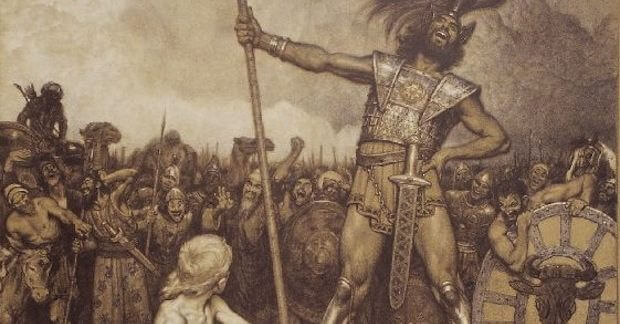


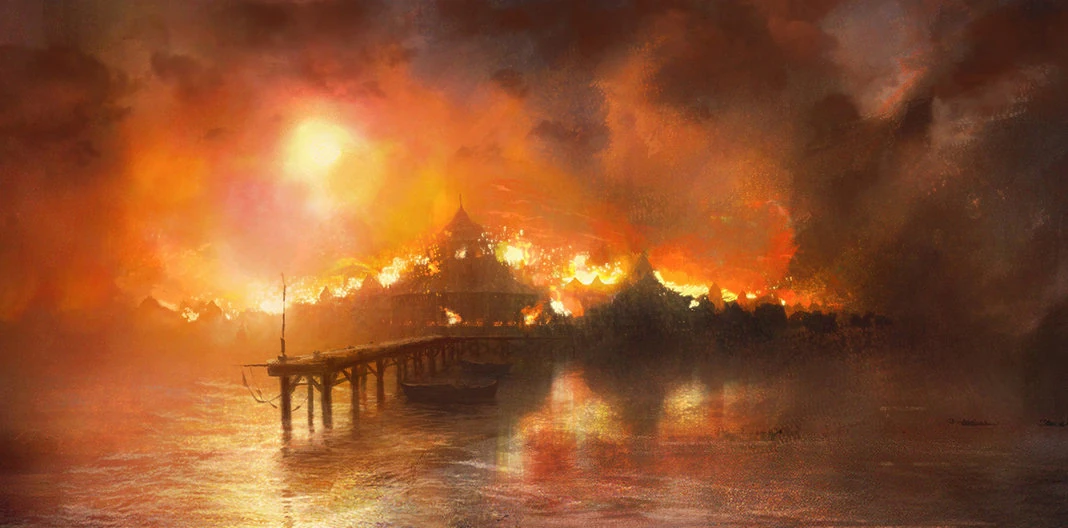


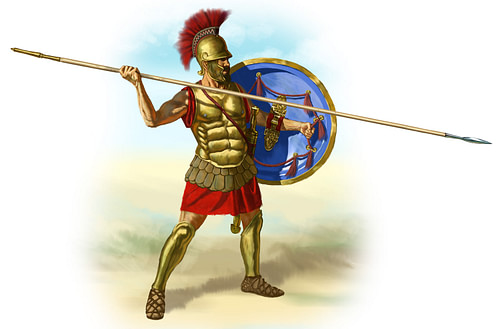


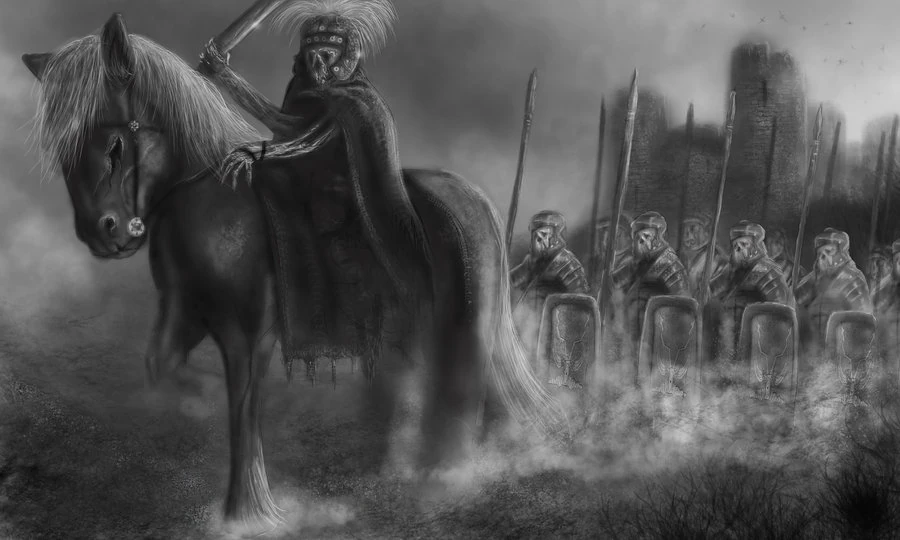


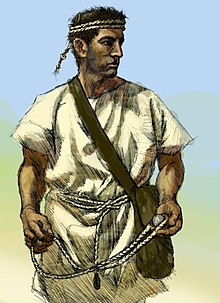


 Tales of Dominions